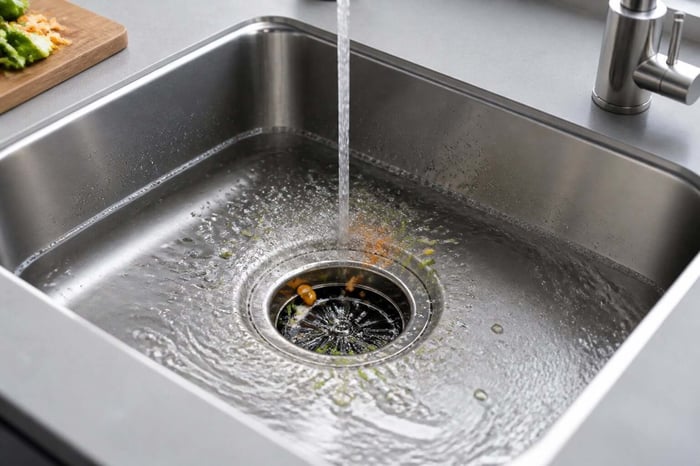

You flip the switch and hear a low, steady hum. A garbage disposal humming means the motor has power, but the blades are not turning. This is one of the most common kitchen problems homeowners run into.
The hum tells you the unit is not dead. It tells you something is stopping it from spinning. In most cases, that something is a jam, and you can clear it yourself in a few minutes without calling a plumber.
Keep reading as Manse explains what the hum is telling you, how to check your disposal safely, and what to do if the quick fixes do not work.
What the Sound Usually Tells You
A humming disposal means the motor has power. That narrows the problem down right away.
Power Is Reaching the Unit
If the disposal were completely dead, you would hear nothing at all. The hum you hear is the motor running but meeting resistance it cannot overcome. The motor is trying to spin, but something is holding the flywheel in place.
This is worth knowing before you start pulling things apart. The issue is not the outlet, not the circuit breaker, and not the wiring. Power is flowing. The fix is almost always mechanical, not electrical.
A Jam Is More Likely Than Total Failure
The most common cause is a jammed flywheel. Inside the disposal, a flywheel spins impeller arms that push food against a shredder ring. When a hard object, such as a fruit pit, a small bone, or a piece of glass, gets caught between the impeller and the shredder ring, the flywheel stops.
Sound | Most Likely Cause |
Hum, no spin | Jammed flywheel |
Nothing at all | No power or tripped breaker |
Loud grinding | Loose or broken object inside |
Hum, then shuts off | Overheated motor, tripped reset |
The good news is that a jam does not mean the motor is burned out. It means the motor was stopped before it could finish the job. Once the jam is cleared, most disposals work fine. Before you do anything else, make sure it is safe to work on.
Safety Steps Before You Touch Anything
Do not skip this step. A humming disposal is one with live electricity running to the motor.
Turn Off Power at the Switch and Breaker
Start by flipping the wall switch to off. Then go to your electrical panel and find the breaker for the kitchen or the disposal circuit. Flip it off. Do not assume the wall switch is enough.
Some disposals are plugged into an outlet under the sink. If yours is, unplug it directly. Either way, cutting power at two points is the safest approach.
Turn off the wall switch
Locate the disposal breaker in your panel
Flip the breaker off, or unplug the unit under the sink
Wait 30 seconds before reaching near the unit
Use a flashlight, not your phone camera, to look inside
Never Put Your Hand Inside the Chamber
Even with the power off, the blades inside a disposal are sharp. Use a flashlight to look down into the drain opening. If you can see an object, use tongs or needle-nose pliers to pull it out. Never use your fingers.
The impeller arms are not true blades, but the shredder ring on the inside wall has sharp grinding teeth. One slip can cause a serious cut even when the unit has no power. Once power is off and you know it is safe to proceed, the actual checks are straightforward.
Quick Checks You Can Do Right Away
These three checks resolve most humming disposals without any special skills or tools.
Look for a Tripped Reset Button
On the bottom of your disposal, there is a small red or black button called the reset button. When the motor overheats or the unit gets overloaded, this button pops out automatically to cut power to the motor.
Press it firmly until you feel it click into place. If it does not stay in, the motor may still be too hot. Wait 10 minutes and try again. Once it clicks and holds, restore power and test the disposal.
Check for a Stuck Object
Shine a flashlight straight down into the drain opening. Look for anything that does not belong, such as a bottle cap, a cherry pit, a small piece of silverware, or a chunk of hard food.
If you spot something, use tongs or pliers to remove it. Do not use your hands. Once the object is out, restore power and test. Most jams clear with this step alone.
Try the Bottom Hex Socket If Your Model Has One
Most disposal models have a hex socket on the bottom center of the unit. It is a small hexagonal opening designed for a 1/4-inch Allen wrench, sometimes called a hex key.
Insert the wrench and turn it back and forth. You are manually rotating the flywheel to break the jam free. You may feel resistance at first, then a release as the stuck object shifts. Turn until the wrench moves freely in both directions, then restore power and test. If none of these steps work, the problem may be more serious than a simple jam.
Signs the Problem Is More Than a Simple Jam
Some symptoms point to a bigger issue. Knowing them saves you from wasting time on fixes that will not help.
Humming With No Blade Movement
If you cleared a visible jam, reset the button, and used the hex wrench, but the disposal still hums without spinning, the motor may be seized. A seized motor means the internal parts have worn or fused together to the point where the motor cannot turn at all.
This is different from a jam. With a jam, the hex wrench moves after some effort. With a seized motor, it either does not move at all or turns freely with no resistance, which means the internal coupling has broken.
Burning Smell or Repeated Shutoff
A burning smell coming from the disposal is a sign the motor is overheating. If the reset button trips every time you restore power, the motor is working too hard and shutting down to protect itself.
Running the disposal while it is jammed puts the motor under heavy strain. If you ran it for more than a few seconds while it was stuck, some motor damage may have already occurred. Repeated shutoffs without a visible jam usually point to a failing motor.
Leaks or Water Damage Around the Unit
A humming disposal that also leaks is a separate, more urgent problem. Water dripping from the bottom of the unit often points to a failed internal seal. Water around the sink flange where the disposal connects to the drain can mean a worn gasket or loose mounting.
Leaks combined with a humming motor are not a DIY fix. Running a unit that is both leaking and overworking the motor can quickly cause water damage under the sink. At this point, the most practical question is whether to repair or replace, and who should do the work.
When to Stop Troubleshooting and Call a Pro
There are two situations where DIY troubleshooting should stop.
Electrical Issues and Motor Failure
If the disposal hums but the hex wrench turns freely with no resistance, the internal drive coupling may be broken. If the reset button will not stay in no matter how long you wait, the motor's thermal overload may be damaged. Neither of these has a simple homeowner fix.
Wiring issues are another reason to call a licensed plumber or electrician. If the disposal is hardwired rather than plugged in, any electrical work beyond flipping a breaker requires a professional.
Trying to open the disposal housing yourself voids most warranties and can cause injury if the unit is not fully de-energized.
Older Units Near the End of Their Lifespan
Most garbage disposals last between 8 and 15 years with normal use. If your unit is in that range, a motor failure or repeated jamming may be a sign it has reached the end of its reliable life.
Age of Unit | Recommended Action |
Under 5 years | Troubleshoot and repair |
5 to 10 years | Weigh repair cost vs. replacement |
Over 10 to 12 years | Consider full replacement |
Any age with burn smell | Stop using, call a pro |
Repairing an older motor can cost nearly as much as a new unit. A plumber can give you an honest comparison once they assess what is actually wrong.
Knowing your unit's age and service history makes that conversation much faster, which leads directly to the habits that make the next problem easier to solve.
How to Prevent the Next Sink Backup
Most disposal problems are preventable. A few consistent habits make a real difference.
What Not to Put Down the Disposal
The items that jam disposals most often are not random. They are the same things homeowners put down the drain every week without thinking twice.
Fruit pits and large seeds (avocado, peach, cherry)
Bones and shellfish shells
Fibrous vegetables like celery, artichokes, and corn husks
Grease, oil, or fat in any form
Pasta, rice, and other starchy foods that expand with water
Coffee grounds in large quantities
Broken glass or small utensils that fall in accidentally
Run cold water before and during use. Cold water keeps fats solidified so they grind rather than coat the shredder ring. Avoid running the disposal dry or without water flowing through the drain.
Keep Model Details and Repair Notes in One Place
If you needed to look up your disposal's warranty right now, could you find it in under two minutes? Most homeowners cannot. The manual is gone, the purchase receipt is in an old email, and the model number requires lying under the sink with a flashlight.
Storing your disposal's model number, install date, warranty period, and any repair notes in Manse means that information is ready the moment you need it. The next time a plumber asks when it was installed or what work was done, you have the answer.
If the unit fails and is still under warranty, you'll know immediately rather than guessing. Adding a disposal to your home profile takes a few minutes and saves real time when something goes wrong.
Frequently Asked Questions
Why Does My Disposal Just Hum When I Flip the Switch, but the Blades Do Not Turn?
The motor is receiving power, but the flywheel is physically blocked. This is almost always a jam caused by a hard object caught between the impeller arms and the shredder ring. Start by cutting power, then check for a stuck object and try the reset button.
What Is the Fastest Safe Way to Unjam a Disposal That Is Stuck and Only Buzzing?
Cut power first at both the wall switch and the breaker. Then insert a 1/4-inch Allen wrench into the hex socket on the bottom of the unit and work it back and forth until the flywheel moves freely. Remove any visible objects with tongs, then restore power and press the reset button.
If the Reset Button Will Not Click or Stay in, What Should I Check Next?
The motor may still be hot from overheating. Wait 10 to 15 minutes and try again. If the button still will not stay in after the unit has fully cooled, the thermal overload inside the motor may be damaged, and the unit likely needs professional service or replacement.
How Can I Tell the Motor Is Burned Out Versus Just Jammed or Tripped?
With a jam, the hex wrench at the bottom of the unit will turn but feel stiff before breaking free. With a burned-out motor, the wrench may turn freely with no resistance, or not move at all. A strong burning smell or repeated immediate shutoffs after resetting are also signs of motor damage.
What Does a Humming Disposal With a Burning Smell Usually Mean, and Should I Shut It Off Right Away?
Yes, shut it off immediately. A burning smell means the motor is overheating, and continuing to run it can cause permanent damage. Cut power at the wall switch and the breaker, let the unit cool fully, and do not attempt to run it again until you have identified the cause.
Why Would a Brand New Disposal Hum but Not Spin on the First Try?
New disposals are sometimes shipped with a locking pin or shipping plug in the drain opening that must be removed before use. Check the installation manual for your model. If the shipping hardware is clear, the unit may have been installed without the flywheel being properly seated, which may require reviewing the installation steps or contacting the manufacturer.
Start Your Home Record Before the Next Problem Arrives
A humming disposal is usually a fixable problem. Most homeowners clear the jam, reset the button, and move on. The frustrating part is not the fix itself. It is not knowing the unit's age, the warranty status, or whether this has happened before.
Add your disposal to Manse for free and keep the model number, install date, warranty, and any repair notes in one private place. If a plumber ever asks what was replaced and when, you will have the answer ready.
Start your home profile today. It is free, it takes a few minutes, and everything you track stays private.