
You turn the shower handle all the way to hot, wait, and nothing changes. The water stays cold, or it warms up for two minutes and then gives up. Somewhere in a closet, garage, or basement, your electric water heater is sitting there looking perfectly normal.
The good news is that most no-heat problems come down to a short list of causes, and several of them cost nothing to check. The hard part is usually not the repair. It is finding the model number on the side of the tank, remembering when the unit was installed, and figuring out whether the warranty still covers a failed part.
Before you call anyone, work through the checks in order, from power supply to heating elements to tank condition, because the cheapest fixes are also the most common ones.
Keep reading to learn how to reset the unit safely, match your symptom to the likely faulty part, test a heating element with a multimeter, and spot the point where a licensed pro should take over. This is more manageable than it feels standing in a cold bathroom.
Start With the Reset Button and Power Supply
Most no-heat complaints trace back to interrupted power, not a dead tank. An electric water heater runs on a dedicated 240 volts, and if that circuit opens, the heating elements simply stop.
Turn Off Power Before Opening Any Access Panel
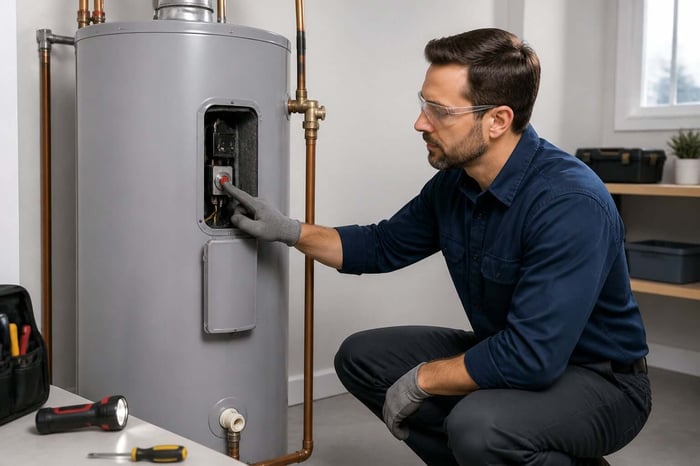
Flip the water heater breaker to OFF at your service panel before you touch a screwdriver. Then remove the access panel and test the wires with a non-contact voltage tester to confirm the power is gone.
Wear gloves and safety glasses. If the tank has been running, give the water time to cool before you work near the thermostats.
Check the Water Heater Reset Button
The reset button is the small red button on the high-limit switch, usually just above the upper thermostat. Press it firmly until you feel or hear a click.
Put the panel back on, restore power, and wait about an hour before testing a faucet. One reset that holds means the switch tripped for a reason worth watching.
Reset a Tripped Circuit Breaker or Replace a Blown Fuse
Look for a breaker that sits slightly out of line with its neighbors. Rock it fully to OFF, then back to ON so the mechanism resets properly.
Older panels use fuses instead. A blown fuse for the water heater circuit needs replacing with the same amperage rating, never a larger one.
Know When a Repeated Trip Signals an Electrical Fault
A breaker or reset button that trips again within days is telling you something is wrong inside the circuit. Common culprits are a shorted heating element, loose wiring at the terminals, or wiring issues in the supply run.
Stop resetting at that point. Repeated trips are a job for a licensed electrician, not another press of the button. If power is fine and the unit still will not heat, the symptom at your faucet points you to the next suspect.
Match the Hot Water Symptom to the Likely Fault
What you feel at the tap narrows the problem down fast. Electric tanks have two heating elements and two thermostats, and each failure produces its own pattern.
Use this quick match to focus your testing:
No hot water at all: upper heating element, upper thermostat, or lost power
Lukewarm water, normal volume: sediment buildup or a weak lower element
Hot water that runs out in minutes: lower heating element
Water too hot or swinging in temperature: thermostat set too high or a faulty thermostat
No Hot Water at Any Faucet
The top of the tank heats first, so a dead upper element or upper thermostat leaves you with a full tank of cold water. Nothing downstream ever gets a turn. If the reset button and breaker both check out, the upper element becomes the prime suspect.
Only Lukewarm Water From the Tap
Plenty of volume but never truly hot usually means sediment is coating the bottom of the water heater tank. That layer insulates the lower element from the water it is supposed to heat.
A worn lower element can produce the same lukewarm water. Flushing the tank is the cheaper thing to rule out first.
Hot Water Runs Out After a Few Minutes
A good first shower that turns cold fast points to the lower element. The upper element heats the top third of the tank, and once you use that, there is no reserve behind it.
Water That Is Too Hot or Changes Temperature
Scalding water usually means one or both thermostats sit above 120 degrees. Water that jumps from hot to cold and back suggests a water heater thermostat that no longer holds its setting. Both cases call for the same next step: measuring the parts instead of guessing.
Test the Heating Elements and Thermostats Safely
A multimeter turns guesswork into a clear answer in about ten minutes. Power must be off at the breaker and confirmed dead before you begin.
Use a Multimeter to Check Element Continuity
Set the meter to the lowest ohms setting and follow these steps:
Remove the access panel and pull back the insulation.
Disconnect both wires from one heating element screw terminal.
Touch one probe to each terminal screw.
Read the resistance and repeat on the second element.
A healthy element typically reads roughly 10 to 16 ohms. No reading at all means the element has failed. A reading between a terminal and the tank means it has shorted to ground.
Check for Voltage Only If You Can Work Safely
Voltage testing on a live 240-volt circuit is a different risk level than an ohms test. If you are not confident holding probes near energized terminals, skip it.
Continuity results usually tell you enough. Leave live testing to an electrician.
Understand What a Failed Upper Element Can Cause
The upper element and thermostat control the sequence for the whole tank. When the upper element opens, the lower one never gets energized, so you get no hot water instead of partial hot water.
That is why a total cold-water symptom rarely means both elements died at once.
Decide Whether a Thermostat Needs Professional Testing
Thermostats test differently because they switch based on temperature, so a cold tank and a warm tank give different readings. If both elements pass and the water still stays cold, a faulty thermostat is likely.
Replacing a thermostat means working inside the same high voltage compartment. Many homeowners test, then hand off. Once the electrical parts check out, the tank itself deserves a look.
Inspect Tank Conditions That Reduce Heating
Some heaters have working parts and still deliver disappointing water. The cause sits inside the tank.
Flush Sediment Buildup From the Tank
Shut off power and the water supply valve. Attach a garden hose to the drain valve, run it outside or to a floor drain, then open the pressure relief valve and the drain valve to let water and sediment out.
Close both valves, remove the hose, refill the tank, and restore power. Doing this once a year prevents the rumbling and popping that come with a sediment layer.
Check the Drain Valve and Water Supply Valve
A drain valve that drips after a flush usually needs a new washer or a cap. Do not overtighten a plastic valve, because they crack easily.
Also confirm the water supply valve is fully open. A partly closed valve limits how much hot water reaches your faucets.
Look for a Damaged Dip Tube or Worn Anode Rod
The dip tube carries cold water to the bottom of the tank. If it cracks near the top, cold water mixes with the hot at the outlet, and every tap runs lukewarm.
The anode rod protects the tank lining from rust and generally needs replacing about every five years. Rusty or rotten-egg smelling water is a sign it is spent.
Treat Leaks and Pressure-Relief Discharge as Warning Signs
Water pooling under the tank or a pressure relief valve that keeps discharging is not a heating problem. It is a pressure or corrosion problem, and a tank with cracks or rust cannot be safely repaired.
Shut off power and water and get a professional plumber out. Knowing when to stop is as valuable as any test you just ran.
Know When to Stop Troubleshooting and Call for Help
Some results tell you clearly that the job has moved past a homeowner fix. Recognizing that line saves money and keeps you safe.
Call a Licensed Electrician for Power or Wiring Problems
Bring in a licensed electrician for repeated breaker trips, scorched or discolored terminals, a burning smell, or loose wiring you cannot safely tighten. The same goes for any suspected wiring issues in the circuit feeding the heater.
Call a Licensed Plumber for Leaks, Valves, or Tank Damage
A licensed plumber handles leaking connections, a failing pressure relief valve, a cracked dip tube, and any damage to the water heater tank itself. If the unit is past 12 years old, ask about replacement cost alongside the repair quote.
Prepare the Model Number, Warranty, and Service History
Before the technician arrives, gather the details that shorten the visit and protect your coverage:
Model and serial number from the rating plate on the side of the tank
Installation date and the name of the company that installed it
Warranty length and whether parts, labor, or both are covered
Dates of past flushes, element replacements, or anode rod service
The test results you just recorded, including ohms readings
Many manufacturers cover a failed heating element or tank for years, but the claim usually needs proof of the install date. Write down today's diagnosis and repair date while it is fresh.
Be Ready for the Next Hot Water Problem
Water heaters fail in predictable ways, and the second time is far easier when your notes are already in one place. A yearly flush reminder and a known warranty end date do most of that work for you.
Frequently Asked Questions
Why Is Your Electric Water Heater Not Getting Hot Even Though It Has Power?
Power at the panel does not mean power reaching the elements. A tripped high-limit reset button, a failed heating element, or a faulty thermostat can all interrupt heating while the breaker stays on.
What Should You Check First When Your Home Suddenly Has No Hot Water?
Check the circuit breaker first, then the red reset button on the upper thermostat. Those two take about five minutes and account for a large share of sudden no-hot-water calls.
How Do You Reset the High-Limit Button on an Electric Water Heater?
Turn the breaker off, remove the upper access panel, pull back the insulation, and press the red button until it clicks. Replace the panel, restore power, and wait roughly an hour before testing a faucet.
How Can You Tell if a Water Heater Heating Element Has Failed?
Set a multimeter to ohms and touch a probe to each terminal screw with the wires disconnected. Around 10 to 16 ohms is normal, while no reading means the element is open and needs replacing.
Why Is Your Brand-New Electric Water Heater Not Producing Hot Water?
New units often ship with the thermostats set low, or the high-limit switch trips during the first fill. Confirm the tank is completely full, check the setting near 120 degrees, and verify the installer wired both elements.
Why Is Your Tankless Electric Water Heater Running but Not Heating the Water?
Tankless models cut back or shut down when flow is too low, a filter is clogged, or an error code is active. Check the display, clean the inlet screen, and confirm the unit has the full amperage it requires.
Getting Your Hot Water Back Without Guesswork
Start with power, move to the symptom, then test the parts. That order finds the cause of an electric water heater not heating in most homes, and it keeps you from replacing a tank that only needed a reset or a flush.
Whatever you find today, the detail worth keeping is the record: the model number, the repair date, the warranty status, and when the tank was last drained. That is exactly what you will wish you had the next time the shower runs cold.
Building a home profile in Manse takes a few minutes, and it is free to start with no credit card required. Add your water heater, upload the manual, and let it remind you before the warranty runs out.