
How to Reset a Water Heater: Step-by-Step Guide
You turn on the shower, wait, and nothing warm comes out. The tank is running, the house is quiet, and you have no idea what just happened. For many homeowners, a tripped reset button on the water heater is the entire problem, and pressing it correctly takes less than five minutes.
Keeping track of your appliance history, including the last time something like this happened, is the kind of detail that gets lost fast. Manse gives you one private place to store it so you are not starting from scratch every time something goes wrong.
Keep reading to learn how to safely reset your water heater, where the reset button is on electric and gas models, why the shutoff tripped in the first place, and what to do if hot water still does not come back. Every step here is written for a homeowner working alone, with no special tools required.
Start With Safety and Basic Checks
Before you touch anything on the unit, cut the power. For electric water heaters, flip the dedicated breaker in your panel to the off position. For gas models, turn the gas supply valve to the off position and wait at least five minutes before doing anything else.
Turn Off Power or Gas if Needed
Once power or gas is off, the unit is safe to approach. Do not skip this step even if the problem seems minor. Electric water heaters run on 240-volt circuits, which carry enough current to cause serious injury if you work with the panel open and power flowing.
If you smell gas near a gas water heater at any point, stop immediately. Leave the house, leave doors open as you go, and call your gas utility from outside. A faint rotten egg smell near the base of the tank is not a reset situation.
Confirm the Problem Is the Water Heater
Before assuming the water heater is at fault, spend two minutes ruling out other causes:
Check that all hot water faucets in the house are cold, not just one fixture
Confirm the circuit breaker for the water heater has not tripped at the panel
Look for visible leaks around the base or connections of the tank
On gas models, confirm the pilot light is out before assuming anything else
If only one faucet has no hot water, the problem is likely a mixing valve or aerator at that fixture, not the heater. If every tap in the house runs cold, you are in the right place. Once you have confirmed the heater is the issue, locating the reset button is the next move.
Find the Reset Button
The reset button on an electric water heater is a small red button, usually labeled "RESET," mounted directly on the upper thermostat inside the access panel. It is the high-limit safety switch, which cuts power to the heating elements when the water temperature climbs too high, typically above 180 degrees Fahrenheit.
Electric Tank Models
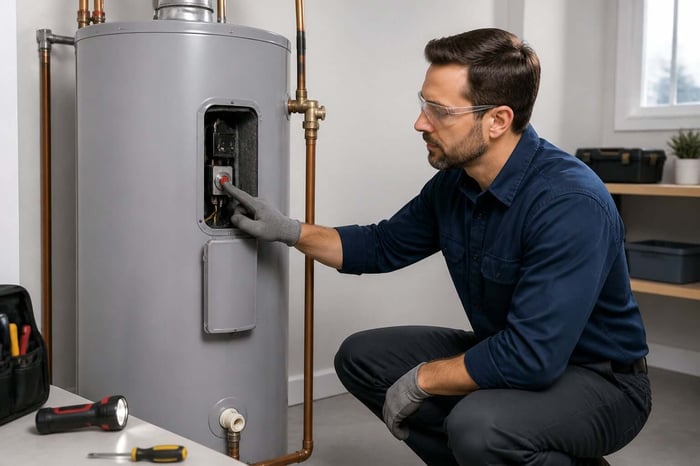
On a standard electric tank water heater, there are two access panels on the side of the unit: one near the top and one near the bottom. The reset button is almost always behind the upper panel.
You will need a flathead screwdriver to remove the panel screws. Behind the panel, peel back the insulation carefully. The red button sits on the thermostat assembly and should be visible once the insulation is moved aside.
Some units, like older Rheem or A.O. Smith electric models, also have a second thermostat at the lower panel, but that lower unit does not have its own reset button. Only the upper thermostat carries the high-limit switch that you will press.
When a Manual Is Missing
If your manual is gone and you are not sure where to look, the model number on the rating plate, usually a sticker near the base or side of the tank, will get you to the manufacturer's support page. From there, you can find a diagram in minutes.
A missing manual is a common frustration, and it tends to come up at the worst possible moments. If you want to avoid that scramble next time, storing your appliance manuals and model numbers in one place before something goes wrong is the practical move. Once you know where the button is, the actual reset process is straightforward.
Press the Reset Button the Right Way
With the panel open and power already off at the breaker, you are ready to press reset. Do not press the button while power is still on. Working inside the panel with live current is the most common mistake homeowners make during this repair.
Opening the Access Panel
Remove the upper access panel screws and set the cover aside. Gently pull back the insulation, which is usually a fiberglass pad, to expose the thermostat and the red reset button. Do not tear or compress the insulation more than necessary. You will need to put it back exactly as it was to keep the heater efficient.
Press the reset button firmly with your finger until you feel or hear a distinct click. If the button does not click or springs back immediately without engaging, the thermostat itself may be faulty and will need replacement. A button that clicks and holds is a good sign. Replace the insulation and reinstall the access panel cover before restoring power.
Restoring Power After Resetting
Go back to the breaker panel and flip the water heater breaker to the on position. The unit should begin heating immediately. For a standard 40- or 50-gallon electric tank, expect to wait 30 to 60 minutes before the water at your tap runs fully hot. Larger tanks, such as 80-gallon units, may take closer to 90 minutes.
Check the tap after about 45 minutes. If water is warming, the reset worked. If the water is still cold, something else is causing the problem, and the next section explains the most common reasons why.
Read more: How to Create a Home Maintenance Checklist when Tasks Keep Piling Up?
Why the Shutoff Tripped
The high-limit switch trips for a reason. Pressing reset fixes the symptom, but if the root cause is not addressed, the button will trip again, sometimes within hours. The three most common causes are a bad thermostat, an electrical fault, or a worn-out high-limit switch.
Overheating From a Bad Thermostat
A thermostat that loses accuracy stops regulating temperature correctly. Instead of holding the water at your set point, usually 120 degrees Fahrenheit, it keeps signaling the heating element to run. The water overheats, the high-limit switch activates, and the heater shuts off. If your water was scalding hot before it stopped working, a failing thermostat is the likely cause.
Loose Wiring or Electrical Faults
Loose or corroded wiring inside the heater can create resistance, which generates heat in the wrong places. That extra heat can trigger the high-limit switch even when the water temperature is normal. If you open the access panel and notice any scorching, melted insulation, or corroded terminals, do not press reset or restore power. That is a job for a licensed electrician or plumber.
High-Limit Switch Wear
The high-limit switch itself can wear out over time, especially on heaters more than 8 to 10 years old. A worn switch becomes overly sensitive and trips even when temperatures are within a safe range.
If the reset button trips again within a day or two of being pressed, and you have ruled out thermostat and wiring issues, the switch itself may need to be replaced. Knowing what triggered the heater's shutoff mode tells you exactly what to do if the water still does not come back.
What to Do if Hot Water Does Not Return
If you pressed reset, restored power, waited an hour, and the water is still cold, the problem is deeper than a tripped switch. Work through these checks before calling a professional.
Test for a Tripped Breaker
Go back to the breaker panel. A water heater breaker that trips immediately after being reset usually signals a short circuit or a failed heating element drawing too much current. If the breaker holds, the electrical supply to the unit is fine. If it trips again within minutes, stop resetting it. Repeated trips can damage the breaker itself.
Check Upper and Lower Elements
Electric tank water heaters have two heating elements: one at the top and one at the bottom of the tank. Either one can burn out independently:
No hot water at all: the upper element is likely failed
Hot water runs out very quickly: the lower element is likely failed
Lukewarm water throughout the tank: both elements may be weak, or sediment buildup is insulating them
Testing elements requires a multimeter set to the resistance setting. A working element reads between 10 and 30 ohms depending on wattage. A reading of zero or infinite ohms means the element is burned out and needs replacement.
Know When to Stop Troubleshooting
If the breaker keeps tripping, if you see scorching inside the panel, or if the reset button will not stay engaged after three attempts, call a licensed plumber or electrician. Continued resets on a unit with a real fault can damage the thermostat, the tank lining, or the wiring.
At that point, knowing your heater's model number, age, and repair history will help the technician diagnose faster and quote accurately.
Prevent the Same Problem From Happening Again
One reset is a minor inconvenience. A reset every few weeks signals a system that needs attention. Two simple steps significantly reduce the odds of repeat trips.
Set a Safer Temperature
The Department of Energy recommends setting your water heater thermostat to 120 degrees Fahrenheit. That temperature is hot enough for showers, dishwashing, and laundry, but low enough to reduce strain on the thermostat and heating elements.
Tanks set above 130 degrees work harder, wear faster, and trip the high-limit switch more often. Adjusting the thermostat takes about five minutes with the access panel open and a flathead screwdriver.
You can also schedule an annual tank flush to clear sediment from the tank's bottom. Sediment creates hot spots that raise water temperatures above the thermostat reading, which is one of the quieter reasons a high-limit switch trips on an otherwise healthy unit. Plan to flush every 12 months if you have hard water, or every 18 months in areas with softer water supply.
Keep Model and Repair Records Handy
When your water heater trips again, or when you need a part replaced, the first thing any technician will ask for is the model and serial number. Those details are on the rating plate, but the plate fades, gets painted over, or ends up behind an access panel, making it hard to read in a dim utility room.
Storing your water heater's model number, installation date, warranty terms, and any repair notes in one place means you are never searching for that information at the worst moment.
Frequently Asked Questions
My Electric Water Heater Isn't Heating. Where Is the Reset Button and What Should I Check First?
The reset button is behind the upper access panel on the side of the tank, mounted on the thermostat and usually colored red. Before pressing it, turn off the breaker, remove the panel, peel back the insulation, and press firmly until you hear a click.
How Long Should You Hold the Reset Button Before Letting Go?
Press the button firmly until you feel or hear a click, then release. You do not need to hold it for more than a second or two. If it does not click or stay engaged, the thermostat may be faulty rather than just tripped.
What Usually Trips the High-Limit Reset on a Water Heater in the First Place?
The most common causes are a failing thermostat that allows water to overheat, a burned-out heating element, or loose wiring generating excess heat inside the unit. Sediment buildup in the tank can also create localized hot spots that push temperatures above the switch threshold.
How Do You Get Hot Water Back After the Gas Supply Has Been Shut Off?
Turn the gas supply valve back to the on position, then follow the relight instructions on the label near the gas control valve at the base of the tank. Most modern gas heaters have a built-in piezo igniter: press the pilot button, hold it for 30 to 60 seconds to heat the thermocouple, then release it and turn the control to the on position.
What Do You Do if Your Water Heater Has No Reset Button You Can Find?
Gas water heaters do not have a user-accessible reset button, unlike electric models. Their reset is tied to the pilot light and gas control valve. If you have an electric model and cannot find the button, check behind the upper access panel first, then consult the model number on the rating plate to find the manufacturer's diagram online.
How Do You Reset a Water Heater Gas Valve When It Won't Light or Stay On?
If the pilot lights but goes out when you release the button, the thermocouple is likely dirty or failing. Hold the pilot button for a full 60 seconds before releasing to give the thermocouple time to heat properly. If it still does not stay lit after two attempts, the thermocouple or gas valve likely needs to be replaced by a qualified technician.
A Reset Is a Starting Point, Not a Finish Line
Pressing the reset button gets your hot water back. Figuring out why it tripped keeps it from happening again next week. Together, a quick fix and a little investigation are usually enough to keep a water heater running reliably for years.
As a homeowner, the details that protect your appliances (model numbers, repair dates, warranty information) are easy to lose and expensive to reconstruct.
Manse is free to start. Add your home in minutes and stop losing track of the details that matter.