
You open the door, the light comes on, and the milk is warm. The unit is humming like always, so nothing seems broken. But the butter is soft, the lettuce is wilting, and you are already doing math on how much food you might lose.
A warm fridge is stressful because you cannot see what is wrong. The good news is that Whirlpool refrigerators fail in patterns. Which compartments are warm and what the fridge sounds like will point you toward the cause faster than opening anything up. Knowing your model number and warranty status before you call anyone saves both time and money.
Keep reading to learn how to match what you are seeing to a likely cause, starting with food safety and settings, then moving through airflow, coils, fans, and the defrost system. Most of these checks take minutes and need no tools.
Start With Food Safety, Power, and Basic Settings
Before you diagnose anything, protect your food and confirm the fridge is actually being told to cool. A surprising number of cooling complaints come down to a setting, a mode, or a tripped breaker.
Protect Food and Check Actual Temperatures
Move milk, meat, and leftovers into a cooler with ice if the refrigerator compartment feels above room-cool. Food held above 40°F for more than two hours is not worth the risk.
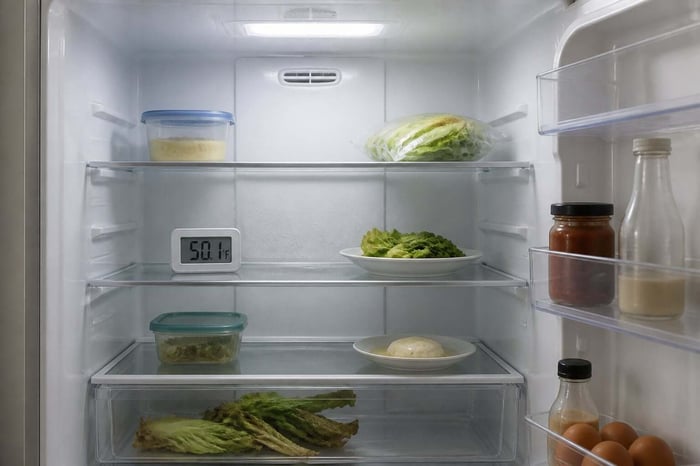
Then get a real number instead of a guess. Put an appliance thermometer in a glass of water in the fridge and another in the freezer compartment. Your target refrigerator temperature is about 37°F, inside a safe range of 33°F to 40°F. Freezer temperature should sit at 0°F.
Confirm Power, the Cooling Function, and Showroom Mode
Check that the display lights up and the interior light works. If both are dead, test the outlet and the circuit breaker. Whirlpool refrigerators should run on a dedicated circuit, not shared with a microwave or disposal.
If the display works but nothing cools, look for a cooling function that has been switched off. Also check for showroom mode, sometimes called demo mode. Store display units use it, and it can be turned on by accident. In showroom mode, the lights and display work while the compressor never runs.
Reset Temperature Controls and Allow Time to Recover
Controls get bumped. A hand or a gallon of juice can shift the setting without you noticing. Work through this quick reset:
Unplug the refrigerator for 5 minutes, then plug it back in
Set the refrigerator to 37°F and the freezer to 0°F
Close both doors and leave them closed
Recheck your thermometers after 24 hours
If temperatures never drop, the problem is mechanical, and the pattern of which side is warm tells you where to look next.
Read more: Appliance Manual Help: Find, Store, and Use It Fast
When Both Compartments Feel Warm
When the fridge and freezer are both warm, something is limiting the whole cooling system: airflow, heat removal at the condenser coils, or the compressor itself.
Clear Air Vents and Reduce Overpacking
Cold air has to move. Air vents inside the cabinet push and pull air, and a packed shelf in front of one shuts down circulation. Pull items away from the back wall and leave a few inches of open space.
Overpacking also traps warm air around new groceries. Give a freshly stocked fridge a day before you judge it.
Clean Dusty Coils Before Suspecting a Major Failure
Dirty condenser coils are one of the most common reasons a Whirlpool refrigerator stops cooling well. Dust, pet hair, and grease act like a blanket, so heat stays inside the system.
Unplug the unit, pop off the kick plate at the bottom front, and use a coil brush and a vacuum. Clean gently and never bend the fins. On some models, the coils sit at the back instead, so check your manual first. Twice a year is a reasonable habit, more often with shedding pets.
Check the Condenser Fan and Compressor Sounds
With the kick plate off, look for the condenser fan near the compressor. It should spin whenever the compressor runs. A fan blocked by lint or a failed condenser fan motor lets everything overheat.
Now listen. A steady low hum is normal on models like the WRS325SDHZ side-by-side. What is not normal:
Clicking every few minutes, then silence, which suggests a start relay or start capacitor
A loud rattle or grinding from the compressor area
A compressor that runs nonstop and still never cools
A breaker that trips when the compressor tries to start
If both sides are equally warm, that list belongs to a technician. If only the fresh food side is warm, the trail goes into the freezer.
When the Freezer Is Cold but the Fridge Is Warm
This is the most common Whirlpool pattern, and it is almost always an air delivery problem, not a dead compressor. All the cooling happens on the evaporator coils behind the freezer wall. A fan then pushes some of that cold air through a duct into the refrigerator compartment.
Look for a Blocked Air Path From the Freezer
Find the vent that feeds the fridge, usually high on the back wall or in the top of a side-by-side. Clear any bags, boxes, or frozen items pressed against it.
Then check the damper that controls how much cold air crosses over. If it is stuck closed with ice or debris, the freezer stays cold while the fridge slowly warms.
Listen for the Evaporator Fan
Open the freezer and hold the door switch in, or press the light switch, so the fan keeps running. You should hear a soft rush of air behind the back panel.
Silence usually means a failed evaporator fan motor. A loud chirp, squeal, or buzz means the fan motor is struggling or its blade is hitting ice. Either way, air is not reaching your food.
Recognize Frost That Points to a Defrost Failure
Look at the freezer's back panel. Heavy frost on that wall, or a solid sheet of ice when the panel is removed, means the defrost system has stopped working. The evaporator coil is buried in ice, so the fan cannot pull air through it.
The usual suspects are the defrost heater, the defrost thermostat, and the defrost timer or control. You can confirm the diagnosis by emptying the fridge, unplugging it, and letting it thaw for 24 to 48 hours with the doors open. If cooling returns and then fades again in a week, the defrost parts need replacing.
Some fridges never fully quit, though, and that in-between behavior has its own set of causes.
When Cooling Is Weak, Uneven, or Comes and Goes
Weak or shifting cooling usually means the fridge is losing cold faster than it can make it. Seals, room conditions, and sensors are the places to look.
Test Door Seals for Escaping Cold Air
Close a dollar bill in the door and pull it out. If it slides out with no drag, that door gasket is not sealing. Repeat the test at several spots along both doors.
Wipe the door gaskets with warm soapy water. Sticky syrup and crumbs keep them from sitting flat. Look for tears, flat spots, or corners that have pulled away. Condensation on food packaging or sweating along the door frame is another clue.
Check Room Conditions and Refrigerator Clearance
Indoor refrigerators struggle in hot garages and cold ones too. If your fridge lives outside the conditioned part of your home, expect uneven refrigerator temperature and freezer temperature in summer.
Clearance matters as well. Most models need about half an inch on the sides and an inch at the back. Push the unit too tightly to a wall or cabinet, and it cannot shed heat. Check that it sits level while you are back there.
Know When Controls or Sealed-System Problems Are Likely
If seals, airflow, and coils all check out, suspect the parts that make the decisions. A drifting thermostat or a failing temperature sensor reports the wrong reading, so the main control board never calls for enough cooling. Symptoms swing: too cold one day, warm the next.
A sealed-system or refrigerant problem looks different. The compressor runs almost constantly, the cabinet sides feel hot, and the freezer only manages 20°F. Frost may form on one small spot of the evaporator and nowhere else.
That is the point where guessing gets expensive.
Know When to Stop Troubleshooting and Prepare for Service
Some repairs are cleaning and organizing. Others involve live voltage, a multimeter, or sealed refrigerant lines that legally require a certified technician.
Warning Signs That Call for a Qualified Technician
Stop and make the call if you see any of these:
The circuit breaker trips when the refrigerator starts
You smell burning or see scorched wiring
The compressor clicks, hums, and shuts off repeatedly, pointing to a start relay, start capacitor, or inverter board
Cooling never returns after the coils, fans, and defrost checks
You would need to open the sealed system to go further
Testing a start relay or main control board with a multimeter is doable for some homeowners, but a wrong diagnosis often means paying twice.
Have the Model Number and Warranty Details Ready
Find the model and serial number before you pick up the phone. On most Whirlpool refrigerators, the label sits inside the fresh food compartment, on the left wall or near the crisper. Write down both, plus the purchase date and installer.
Warranty status changes the math. A sealed-system repair may still be covered years after the one-year parts warranty ends. Having that paperwork in hand, instead of digging through email, is the difference between a covered repair and a $600 bill.
Frequently Asked Questions
Why Is Your Whirlpool Fridge Not Cooling Even Though the Light Is On?
The light runs on a separate circuit from the cooling system, so it works even when the compressor does not. Check for showroom mode, a cooling function that is switched off, or a failed condenser or evaporator fan. A lit interior only proves the fridge has power.
What Should You Check First When Your Whirlpool Refrigerator Stops Cooling?
Start with the temperature settings, the breaker, and the outlet, then check the condenser coils under the kick plate. These four checks solve a large share of cooling complaints and take under 20 minutes. Move perishable food to a cooler while you work.
Why Is the Freezer Cold but the Refrigerator Section Warm?
Cold air is made in the freezer and blown into the fridge, so a blocked vent, a stuck damper, or a dead evaporator fan motor strands that air. Heavy frost on the freezer's back wall points to a defrost system failure instead. The compressor is usually fine in this situation.
How Do You Reset the Cooling System on Your Whirlpool Refrigerator?
Unplug the refrigerator for about 5 minutes, plug it back in, then set the fridge to 37°F and the freezer to 0°F. Keep the doors closed and recheck temperatures after 24 hours. A reset clears control glitches but will not fix a failed part.
Does Your Whirlpool Refrigerator Have a Reset Button?
Most Whirlpool refrigerators have no dedicated reset button. Unplugging the unit or switching off its circuit breaker for a few minutes does the same job. Some touchscreen models let you reset settings through the control panel menu.
Why Is Your New Whirlpool Refrigerator Not Getting Cold?
A new refrigerator needs up to 24 hours to reach its set temperature, and longer if it was just loaded with groceries. Confirm showroom mode is off, the doors seal fully, and clearances at the back and sides are correct. If it is still warm after a full day, call while the warranty is fresh.
Getting Your Fridge Cold Again Without the Guesswork
Match the symptom first. Both sides warm points to coils, the condenser fan, or the compressor. A cold freezer with a warm fridge points to airflow, the evaporator fan, or defrost. Weak, drifting cooling points to seals, sensors, or the sealed system.
Once the fridge is cold again, spend five minutes writing down what happened. The model number, the repair date, the part, the cost, and when the warranty ends.
Add your home to Manse and keep this repair documented where you can actually find it next time. It is free to start, no credit card required, and your records stay private and encrypted.