
You flip the switch, and nothing happens. Learning how to reset garbage disposal units is a simple skill that can save you a service call and get your kitchen running again in minutes.
The most common reason a garbage disposal stops turning on is a tripped internal circuit breaker, and resetting it is as simple as pressing one small button on the bottom of the unit. Knowing where that button is and what to check after you press it is usually all you need to get the disposal running again.
Keep reading to learn the exact steps to reset your disposal safely, how to clear a jam, and how Manse helps you track these maintenance tasks for the future.
What the Reset Button Actually Does
The reset button is a built-in safety feature, not a quirk. When something trips the disposal's internal circuit breaker, pressing that button restores the circuit and resumes power to the motor.
Why a Disposal Shuts Itself Off
Your disposal has an internal circuit breaker that watches for overload conditions. When the motor overheats, a jam stalls the grinding plate, or too much food hits it at once, the breaker trips, cutting power to protect the unit from burning out.
This is a feature, not a failure. The disposal shuts off before damage can happen. Once it cools down and the problem is resolved, the reset button restores the circuit, allowing the unit to run again.
Most disposals need five to ten minutes to cool after a thermal trip. If you press the reset button too soon, it may pop back out immediately without clicking in, indicating the motor is still too hot.
Where to Find the Button
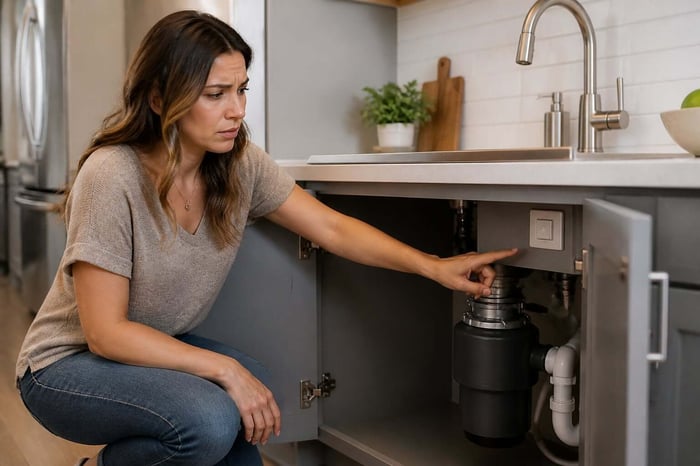
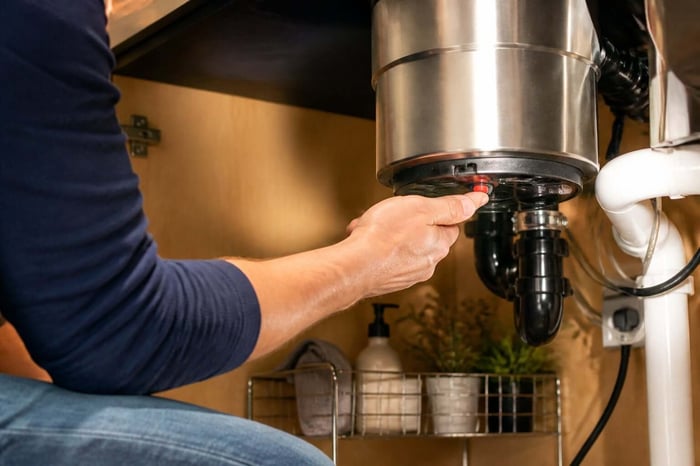
Look under the sink, directly at the bottom of the disposal unit. The reset button is a small red or black button, usually centered on the bottom of the housing.
Shine a flashlight if the cabinet is dark. The button is recessed slightly and will feel springy when you press it. If it is already pushed in and does not click, the breaker may not have tripped, and the problem lies elsewhere.
Brand | Button Color | Button Location |
InSinkErator | Red | Bottom center of housing |
Waste King | Red | Bottom center of housing |
Moen | Black or red | Bottom center of housing |
Kohler | Red | Bottom center of housing |
Once you know where the button is and why it trips, you are ready to work safely before you touch anything.
Safety Checks Before You Touch Anything
Do not touch the disposal, look inside the drain, or reach under the sink until power is off. A disposal that appears completely dead can still move if power is still connected.
Cut Power at the Switch and Breaker
Start by turning the wall switch to the off position. That switch controls the unit, but it does not always cut all power to the outlet the disposal plugs into.
If you plan to put a tool inside the drain or reach under the unit, go to your electrical panel and flip the breaker for the kitchen disposal circuit. Label it if you have not already. Two minutes on the panel are worth the protection they give you.
If your disposal is plugged into a standard outlet under the sink, you can also unplug it directly. Pull the plug completely out of the outlet before doing anything else.
What Never to Put Your Hand Near
Never put your fingers into the drain opening, even with the power off. The grinding plate has sharp edges that can cut even when the unit is completely still.
If you need to look inside, use a flashlight held above the drain opening. If you see something stuck, use needle-nose pliers or long tongs to pull it out. Never use your fingers.
Never reach into the drain with bare hands
Never assume the disposal is safe because it is quiet
Never skip the breaker step if you are using a tool on the unit
Never run water into the drain until power is fully restored and confirmed
With power confirmed off, you are ready to work through the actual reset process.
Steps to Get It Running Again
Start with the simplest fix first. Most disposal failures that involve neither sound nor movement are resolved in the first two steps below.
Press the Reset Button the Right Way
Wait at least five minutes after the disposal stopped, then crouch down and look at the bottom of the unit. Press the reset button firmly until you feel it click in.
If the button pops back out immediately, the motor is still too warm. Wait another five minutes and try again. You should hear a soft click when the button seats properly. That click means the internal circuit is restored.
Once the button is seated, restore power at the breaker, turn on cold water, and flip the wall switch. If the disposal starts, you are done.
Check the Wall Switch and GFCI Outlet
If the reset button is seated and the disposal still does not run, check the outlet it is plugged into. Some disposals are wired into a GFCI outlet, which has its own reset button, separate from the disposal's.
Look for a white or gray outlet under the sink with two small buttons labeled "Test" and "Reset." Press the Reset button firmly. Unplug the disposal, press the GFCI reset, then plug it back in and test the switch again.
GFCI outlets are not required for disposals under the National Electrical Code, but some kitchens have them installed anyway. It is worth checking before you assume the disposal itself is at fault.
Look for a Tripped Circuit Breaker
If neither the reset button nor the GFCI outlet resolved the issue, go to your electrical panel. Find the breaker labeled for the kitchen disposal or kitchen circuits.
A tripped breaker sits between the On and Off position. Push it fully to Off first, then firmly back to On. Return to the kitchen, run cold water, and test the switch. If the disposal still does not respond, the problem is inside the unit itself, which the next section covers.
If the Motor Hums but Will Not Spin
A humming disposal is not dead. It means power is reaching the motor, but something is stopping the grinding plate from turning.
How to Clear a Jam From Below
Most garbage disposals have a hex socket on the very bottom of the unit. It is a small opening in the center, designed for a 1/4-inch Allen wrench. This is how you manually turn the grinding plate to break a jam loose.
With power confirmed off, insert the Allen wrench into the socket and work it back and forth. You will feel resistance, then the plate will begin to move more freely. Once it turns a full rotation without catching, the jam is likely cleared.
Restore power, run cold water, and press the reset button if needed before flipping the switch. The hum should be gone, and the disposal should spin normally.
Signs Something Is Stuck Inside
Before you use the Allen wrench, look into the drain with a flashlight. A fork, a bottle cap, a pit from a piece of fruit, or any hard object can lock the plate in place.
Signs something is jammed inside include:
The motor hums for a second then cuts out
The plate feels locked when you try the Allen wrench
You hear a grinding or clicking sound before it stops
If you spot the object, use pliers or tongs to remove it. Never use your fingers. Once the object is out, try the Allen wrench again to confirm the plate moves freely before restoring power.
When a Simple Restart Will Not Fix It
If you have pressed the reset button, checked the breaker, cleared a jam, and the disposal still fails, the issue is likely mechanical or electrical inside the unit itself.
Clues the Unit May Be Failing
Most garbage disposals last around 10 to 15 years with regular use. If yours is in that range, repeated resets and jams are a signal the motor is wearing out rather than a series of unrelated problems.
Watch for these warning signs:
The motor trips the reset button regularly, even after small loads
The unit leaks from the bottom, not just around the sink flange
You smell burning plastic or hot metal after short use
The disposal runs but grinds much more slowly than it used to
A single reset is normal. Needing to reset the same unit every few days is not.
When to Call a Plumber or Electrician
Call a plumber when the disposal leaks from the bottom, makes a loud grinding or metal-on-metal sound, or does not respond at all after you have worked through every step above.
Call an electrician if the disposal circuit breaker trips repeatedly after being reset, or if the outlet under the sink shows signs of damage, such as scorch marks, a loose connection, or a burning smell. Electrical problems at the outlet or panel are not DIY fixes.
Knowing which professional to call saves you time. Plumbers handle the unit and the drain connection. Electricians handle the wiring, outlet, and breaker.
How to Prevent the Next Sink Shutdown
A little consistency in what goes down the drain goes a long way toward preventing the reset-button situation from recurring.
Habits That Reduce Jams and Overloads
Run cold water before you turn on the disposal, keep it running during grinding, and let it run for about 15 to 20 seconds after you turn it off. Cold water helps solidify fats so they grind and flush through rather than coating the grinding plate.
Feed food in small amounts rather than pushing a large pile in at once. The motor handles consistent small loads much better than a single large one. Hard items like bones, pits, and shells can bend or nick the grinding plate and should go in the trash instead.
Foods to keep out of the disposal:
Fibrous vegetables like celery and artichoke leaves
Starchy foods like pasta, rice, and potato peels
Hard items like bones, fruit pits, and shells
Grease, oil, or fat in any form
Coffee grounds in large quantities
What to Record After a Repair
After any disposal repair, write down what happened, what you fixed, and when. That information has real value the next time something goes wrong, or when a plumber asks about the unit's history.
At minimum, record the disposal's brand, model number, and install date. Add any service notes, whether you cleared a jam, replaced the unit, or called a technician. If the unit is still under warranty, note the expiration date.
This is exactly the kind of appliance record that Manse is built to hold. You can log your disposal, store the model number and warranty details, and set a reminder to check on the unit annually, all in one private place. When the next problem shows up, you will have the full history ready.
Frequently Asked Questions
Where Is the Reset Button Located on Most Garbage Disposals?
The reset button is located at the bottom of the disposal unit housing, usually in the center. It is a small red or black button that is slightly recessed. Shine a flashlight into the cabinet under your sink and look directly at the bottom of the cylindrical unit.
How Long Should You Hold the Reset Button Before Trying It Again?
You do not hold the reset button. Press it firmly until you feel it click in and stay in. If it pops back out right away, the motor is still too hot. Wait five to ten minutes and try again.
What Should You Do if the Disposal Hums but Will Not Spin?
A hum means power is reaching the motor, but the grinding plate is stuck. Insert a 1/4-inch Allen wrench into the hex socket on the bottom of the unit and work it back and forth until the plate turns freely. Then restore power and press the reset button before flipping the wall switch.
How Do You Free a Jam Using an Allen Wrench From Underneath?
With power fully off at the switch and breaker, insert a 1/4-inch Allen wrench into the hex socket centered on the bottom of the disposal. Move the wrench back and forth to manually rotate the grinding plate. Once it turns a full circle without catching, the jam is cleared.
Why Does the Disposal Have Power but Will Not Run at All?
The most likely causes are a tripped internal reset button, a tripped GFCI outlet, or a tripped circuit breaker. Work through each one in that order before assuming the motor has failed. If all three are confirmed normal and the unit still does not respond, the motor may need professional evaluation.
Will Unplugging the Unit for a Minute Clear a Trip or Reset It?
Unplugging the disposal can help if the motor needs to cool, but it does not replace pressing the reset button. After plugging the unit back in, you still need to press the reset button until it clicks before the internal circuit is restored and the disposal will run.
Keep Your Disposal Running and Your Records Ready
Most disposal failures resolve in under ten minutes. The reset button handles most dead-unit situations, and a 1/4-inch Allen wrench handles most hums. The problems that do not fall into those two categories tend to be clear: the unit is old, something is electrically wrong, or a jam is visible inside the drain.
The harder part is not fixing the disposal. It is remembering what you did, when you did it, and whether the unit is still under warranty the next time it acts up. That information is easy to lose and surprisingly hard to reconstruct from memory two years later.
Add your home to Manse for free and keep all appliances, warranties, and maintenance records in one private place. Start your home profile today. It is free, it takes a few minutes, and everything you track stays private.