
You are standing at the sink, water pooling above a pile of food scraps, and the switch does nothing. A garbage disposal that stopped working mid-rinse is one of those small disasters that feels bigger than it is, especially when your hands are wet and dinner cleanup is only half done.
Most of the time, the fix takes less than fifteen minutes and does not require a call to anyone. Once your disposal is running again, it is worth a quick note somewhere you can find later. Manse is where homeowners keep that kind of detail: the model number, the install date, whatever warranty paperwork came with it, so the next hiccup takes less guesswork.
Keep reading to learn the exact order to check things, starting with the easiest fix and working toward the ones that mean you should stop and call a plumber. No jargon, no filler, just what you need to fix the problem and keep a record for next time.
Use This Four-Step Diagnostic Sequence
You flip the switch, nothing happens, and now you are staring under the sink wondering where to even start. When your garbage disposal not working turns into a guessing game, the fastest path back to a working sink is a set order, not random button-mashing.
Before troubleshooting the unit itself, it helps to know where its details live. Manse gives homeowners a private spot to store appliance model numbers and warranty dates, so if this disposal ever needs a professional's help, the basics are already on hand.
Here's a four-step sequence covering the most common reasons a disposal quits, in the order you should try them. For the fuller walkthrough of any single step, Manse's guide to resetting a garbage disposal covers step one in more depth.
Press the Reset Button First
Almost every disposal has a small red or black button on the bottom or side of the unit, called the reset button. It works like a mini circuit breaker for the motor itself.
When the disposal overheats, often from too much food waste or something stuck against the impeller, this button pops out to protect the motor. Reach under the sink, find the button, and press it firmly until you hear or feel it click.
Confirm Power at the Breaker and Outlet
If the reset button did not solve it, check the power supply next. Look at your home's circuit breaker panel for a tripped switch, and check the electrical outlet under the sink to make sure the disposal is still plugged in.
Some kitchens run the disposal on a GFCI outlet shared with the dishwasher. A tripped GFCI can cut power without tripping the main breaker, so press the reset button on the outlet itself too.
Check for a Stuck Grinding Mechanism
No power issue, and the disposal still will not run? A jammed flywheel is the next likely culprit, especially if you hear a hum instead of silence.
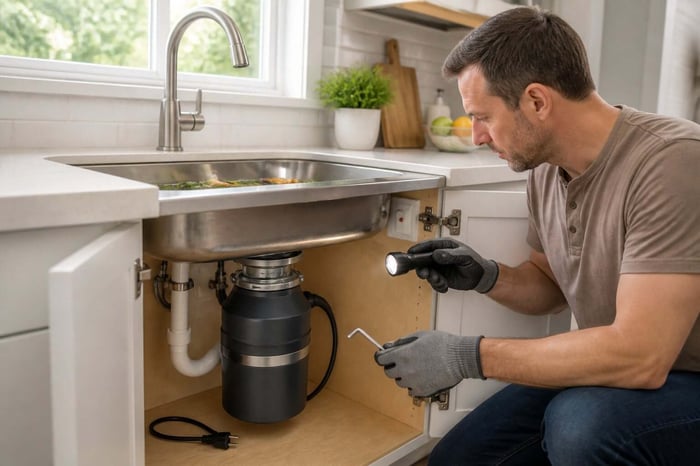
Cut power to the unit completely before touching anything inside it. Use the hex key that came with your disposal, insert it into the slot on the bottom center of the unit, and turn it firmly back and forth to free whatever is stuck.
Stop If the Motor Will Not Recover
If you have pressed the reset button, confirmed power, and cleared any jam, and the disposal still will not run, stop troubleshooting on your own. This usually points to a burned-out motor or a wiring issue.
At this point, an electrical problem inside the unit is more likely than something you can fix with a wrench. Garbage disposal repair at this stage is a job for a licensed electrician or plumber.
Restore Power When the Unit Is Silent
You flip the switch and get total silence, not even a hum. That kind of quiet is its own clue when a garbage disposal stops working, and it usually points somewhere different than a jam.
Before you dig further, it is worth pausing to think about where you would find the model number if you needed to call someone. Manse keeps that kind of appliance detail stored and private, ready whenever you need it instead of buried in a drawer.
This garbage disposal not turning on guide covers this exact scenario in full, but here are the three places to check first, and how to know when the fix is beyond a homeowner's toolkit.
Check the Plug, GFCI Outlet, and Circuit Breaker
Start at the source. Confirm the disposal is plugged in, since under-sink storage often knocks the cord loose.
Check the GFCI outlet for a tripped reset, and look at your home's circuit breaker panel for a flipped switch. A silent disposal is almost always an electrical problem before it is anything mechanical.
Reset an Overheated Unit After It Cools
If the disposal ran hot recently, from grinding too much at once or running dry, it may have shut itself off to protect the motor. Give it ten to fifteen minutes to cool down completely.
After that, press the reset button on the bottom of the unit. This step alone solves a large share of silent-disposal cases.
Recognize When a Wall Switch or Wiring Problem Needs Help
If power checks out everywhere and the reset button clicks fine, but nothing happens, the wall switch or internal wiring may be the actual problem. Testing a wall switch safely means cutting power first and checking with a voltage tester, which is not a step to guess at.
At this stage, garbage disposal problems tied to wiring call for an electrician. A malfunctioning garbage disposal with no electrical response, no hum, nothing, sometimes means a burned-out motor that a professional plumber will need to confirm before replacement.
Free a Humming Disposal Safely
You flip the switch and hear a hum, not silence, but the blades will not spin and the sink is not draining. Garbage disposal humming but not working is a different problem than a dead unit, and it usually means something is physically stuck.
Once you clear the jam, it is a good moment to jot down what happened and when. Manse lets you log that kind of maintenance note alongside your disposal's other details, so a pattern of jams over time is easy to spot.
Manse's garbage disposal humming guide goes deeper on this symptom specifically; here's the safe way to clear a jammed impeller without risking your hands.
What Humming Without Grinding Usually Means
A hum tells you the motor has power and is trying to spin the flywheel, but something is blocking it. Common culprits include bone fragments, fruit pits, glass, or a utensil that fell into the drain.
Left alone, a jammed impeller can overheat the motor and trip the thermal overload protector. Clearing it quickly protects the unit long-term.
Remove Visible Objects Without Using Your Hands
Cut power to the disposal at the switch and the breaker before doing anything else. Never reach into the disposal with your hands, even with the power off.
Use long pliers, tongs, or a wooden spoon to pull out any visible object. A flashlight helps you see food particles or debris caught around the shredder ring.
Turn the Flywheel With the Correct Wrench
Find the hex-shaped hole in the center of the disposal's underside. Insert a hex wrench (sometimes called a hex key or Allen wrench) and turn it firmly in both directions to rotate the flywheel and dislodge the jam.
Keep steady pressure rather than jerking the wrench
Turn in small increments if it feels stuck
Stop and remove any freed debris before continuing
Test the Disposal With Cold Water
Once the flywheel turns freely, restore power and run cold water into the sink. Turn on the disposal in short bursts to confirm it spins smoothly without humming.
Cold water helps solidify any remaining grease so it grinds instead of smearing. If the hum returns immediately, there may be a second object still lodged inside.
Clear Slow Drainage and Trace Any Leak
The disposal runs fine, but water is backing up in the sink, or worse, you notice a puddle forming in the cabinet below. These two issues get lumped in with a garbage disposal stopped working, but they point to plumbing, not the motor.
Details like this are easy to forget once the sink drains again. Keeping a private record in Manse of what you fixed and when means the next slow drain does not start you from zero.
This guide to unclogging a garbage disposal covers this in full detail; here's how to clear a drain blockage and pinpoint exactly where a leak is coming from.
Use a Cup Plunger for a Nearby Drain Blockage
A standard cup plunger works well for a blockage close to the drain opening. Fill the sink partway with water first so the plunger has something to push against.
Plunge several times firmly, then run water to check if drainage improved. This step alone clears many slow-drain complaints tied to food waste buildup.
Inspect the P-Trap and Discharge Pipe
If plunging does not help, the clog may sit lower, in the P-trap or discharge pipe. Place a bucket underneath, then loosen the trap's slip nuts by hand or with pliers.
Empty any trapped debris and food scraps, then reassemble and test with water. This is also a good time to check the discharge pipe for cracks or buildup.
Find Whether Water Is Coming From the Flange, Dishwasher, or Bottom
A garbage disposal leaking can come from several spots, and each points to a different fix. Check the sink flange at the top, the dishwasher connection hose, and the bottom of the unit itself.
Dry everything, run water, and watch closely to trace the source. A leak from the bottom housing usually means the unit needs replacing rather than repair.
Avoid Chemical Products That Can Damage the Unit
Chemical drain cleaners can corrode the disposal's internal parts and rubber seals over time. They also do little for clogs caused by solid food scraps rather than grease.
Stick to mechanical methods like plunging and manual clearing. If the clog persists after these steps, a licensed plumber can inspect the line without risking damage to the unit.
Prevent the Next Jam and Know When to Replace It
You just got the sink draining again, and the last thing you want is a repeat of the same frustration next week. A garbage disposal that stopped working once often points to habits worth adjusting before the next jam forms.
This is also the easiest moment to build a lasting record. Manse keeps your disposal's maintenance notes, warranty details, and service history in one private place, so patterns and paperwork are not scattered across drawers and old emails.
Here are simple prevention habits and a clear line for when it is time to call a pro instead of trying yourself again.
Keep Fibrous and Starchy Foods Out of the Grinder
Fibrous vegetables like celery and corn husks wrap around the impeller instead of breaking down. Starchy foods like pasta and rice expand with water and can clog the drain line further down.
Coffee grounds, grease, and oil are two more common offenders. Grounds build up in the trap over time, and grease solidifies inside pipes once it cools.
Flush Small Batches With Cold Water
Feed food waste into the disposal gradually rather than dumping large amounts at once. Run cold water before, during, and for a few seconds after grinding.
Cold water keeps any grease firm enough to grind and flush through rather than smear along the pipe walls. Ice cubes can also help scrub the inside of the chamber occasionally.
Use Simple Cleaning Habits Instead of Harsh Chemicals
A baking soda and vinegar mix, followed by a cold water rinse, helps break down odor-causing buildup without harming the disposal's parts. Lemon peels ground briefly can freshen the smell too, though they should not be relied on for cleaning power alone.
Baking soda and vinegar for odor and light buildup
Cold water flush after every use
Occasional ice cubes to help clear residue
Call a Pro for Repeated Trips, Leaks, or Motor Failure
If you find yourself unjamming the same disposal every few weeks, that is a signal, not a coincidence. Repeated jams, leaks from the housing, or a motor that will not restart after resetting usually mean it is time to call a plumber.
Garbage disposal repair costs can add up if the same problem keeps returning. Replacement is often the more practical choice once a unit shows this pattern.
Frequently Asked Questions
Why did my garbage disposal suddenly stop working?
The most common causes are a tripped reset button, a tripped circuit breaker, or a jammed flywheel from food debris. Less often, a burned-out motor is to blame, especially in units older than eight to ten years.
What should I check if the garbage disposal has power but will not run?
Press the reset button on the bottom of the unit first. If that does not work, check for a jam using a hex wrench in the center hole, since a stuck flywheel can prevent the motor from turning even with power present.
Why is my garbage disposal humming but not grinding food?
Humming means the motor has power, but something is physically blocking the flywheel. Cut power, remove any visible debris with pliers or tongs, and use a hex wrench to rotate the flywheel free.
How do I reset a garbage disposal after it stops working?
Locate the small reset button on the bottom or side of the unit and press it firmly until it clicks. If the unit recently overheated, let it cool for ten to fifteen minutes before pressing the button.
What does it mean when the garbage disposal makes no sound at all?
Complete silence usually points to an electrical problem, not a jam. Check the plug, the GFCI outlet, and the circuit breaker before assuming the motor has failed.
How can I tell whether the garbage disposal motor has burned out?
If the reset button clicks, power is confirmed at the outlet and breaker, and no jam is present, but the unit stays silent, the motor has likely burned out. A licensed electrician or plumber can confirm this before you decide on repair or replacement.
Keep Disposal Records Ready for the Next Service Call
Whether you replace the unit or just had it serviced, the model number and installation date matter for warranty coverage.
Manse stores that information privately, so it is ready the moment you need it, not something you are digging for while a plumber waits on the phone.