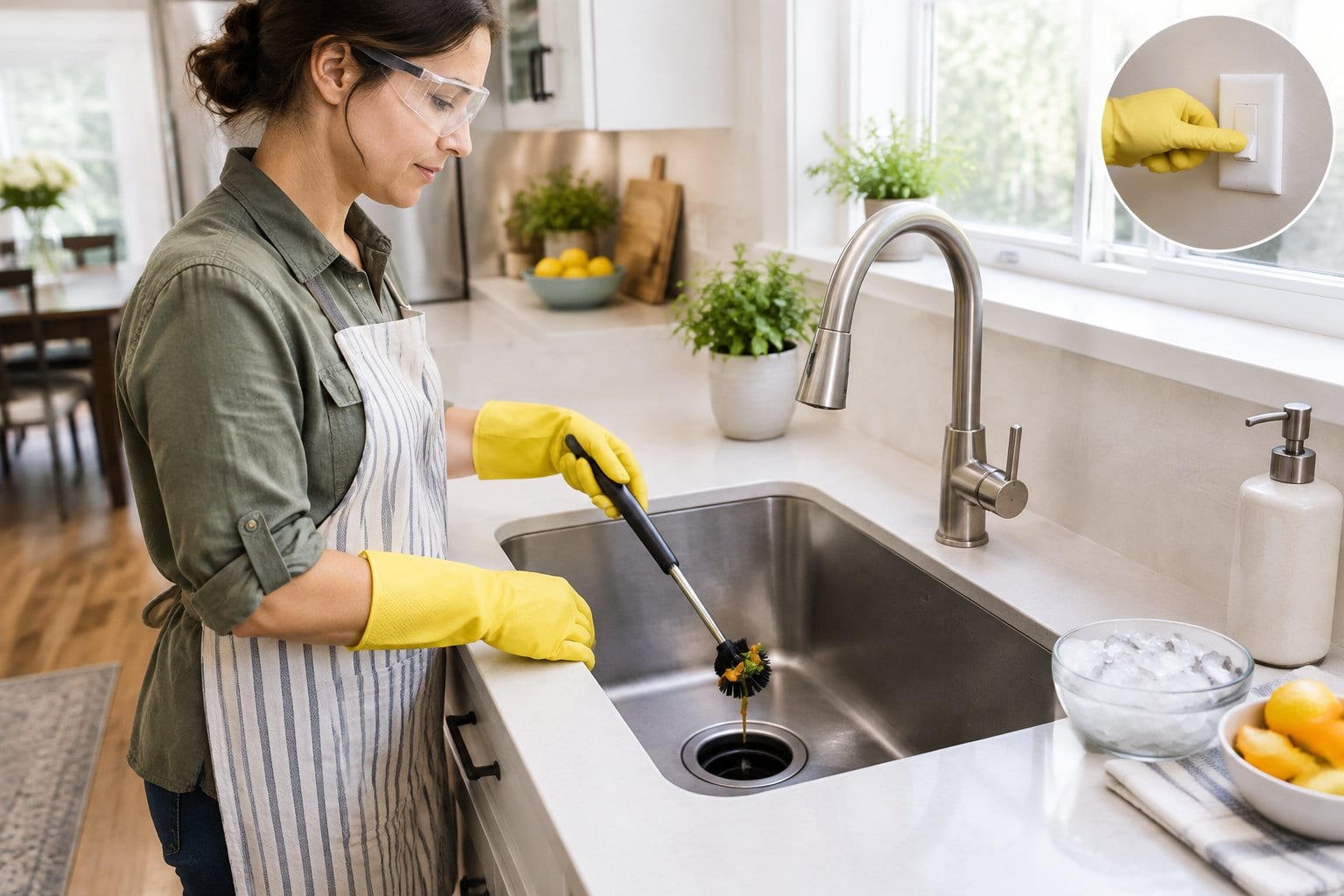

To clean a garbage disposal safely, cut its power first, lift out any debris with tongs, then scrub the rubber splash guard and the top of the grinding chamber with dish soap and a stiff brush. Once the power is back on, let the unit run under a cold tap. That smell drifting up from the sink almost always comes from a gray-black film on the underside of the splash guard flaps, a spot the grinder never touches and the one most quick fixes miss.
Ice, citrus and baking soda all have a place, but as finishing touches. The hand scrub is what actually removes the buildup.
Cut the Power, and Prove It's Off
Every step below puts a hand, a brush or tongs inside the drain opening, so the disposal has to be dead, not just switched off. Most units plug into an outlet inside the sink cabinet. Pull that plug. If yours is hardwired, switch off its breaker at the panel. Then flip the wall switch or press the air switch on the counter and confirm nothing happens.
InSinkErator's own clog guidance starts the same way, with turning the disposal off and disconnecting the power supply. Treat that as non-negotiable even for a two-minute job.
The Hand Clean, Step by Step
- Shine a flashlight down the drain and lift out anything visible, such as fruit pits, a bottle cap or a twist tie, using kitchen tongs or needle-nose pliers. Keep fingers out even with the power off. There are no true blades, but the grind ring has sharp edges.
- Work out whether your splash guard lifts out. On some models it pulls straight up from the collar, and on others it's molded into the mounting and stays put. Don't force a fixed guard, because yanking on it can tear the rubber or disturb the sink flange seal.
- Scrub the guard. A removable one comes out for a scrub on both sides with dish soap and an old toothbrush, paying attention to the slits between the flaps. For a fixed guard, fold each flap back with the toothbrush and clean the underside where it sits.
- Clean the upper chamber. Put a few drops of dish soap on a long-handled bottle brush and scrub the sloped walls just below the guard and the rim of the drain, rinsing the brush until it comes up clean. The top few inches are what matter. Grinding keeps the lower chamber reasonably clear.
- Refit the guard so it seats evenly, restore power, and run the disposal with a strong flow of cold water for about half a minute to carry loosened residue through the trap.
If the guard itself is cracked, stiff or missing flaps, a replacement is inexpensive and fitting one is often the single biggest improvement to a smelly sink. Guards are sized to the disposal, so get the part listed for your model.
Ice, Citrus, Baking Soda: What Each One Really Does
Ice
Grinding a few handfuls of ice cubes knocks some hardened residue off the impellers and grind ring, and a little coarse salt with the ice adds grit. InSinkErator, which publishes three cleaning methods for its own units, points out the catch: the ice usually melts before it has cleaned the whole grind chamber. Use it as a polish after the hand scrub, not instead of it.
Citrus
The same InSinkErator page suggests grinding lemon or orange wedges one at a time under a steady stream of cool water. It leaves the drain smelling fresh and helps a little with light film. It does nothing for slime under the guard. Feed small pieces gradually rather than a whole rind at once.
Baking soda and vinegar
Baking soda absorbs odor and the fizz from vinegar loosens light film, but neither one breaks up a clog. Pour half a cup of baking soda into the drain, follow it with a cup of white vinegar, wait ten minutes, then flush with cold water while the disposal runs. Vinegar is acidic, so this works best as an occasional freshen-up rather than a weekly routine, for the sake of the rubber guard.
What Not to Pour Down It
Chemical drain openers and lye don't belong in a disposal. They can attack metal parts and seals, and if they fail to clear a blockage you're left with a sink full of caustic water that someone has to reach into. Bleach is unnecessary for routine cleaning. If you use it at all, dilute it heavily and never combine it with vinegar, ammonia or another cleaner, because those combinations release dangerous fumes.
Hot water is the other common mistake. It feels like it should help, but it melts grease that then sets again further down the pipe. InSinkErator says to avoid hot water while grinding and to keep cold water running for a few seconds after grinding stops. The same page is blunt that grease and fat should never go down the drain at all.
Habits That Keep the Smell From Coming Back
How often you need to scrub depends on how hard the disposal works. In a kitchen where it runs after every meal, a quick guard clean every week or two keeps ahead of the film. Lighter use can stretch to monthly. A returning smell is the most reliable signal.
What goes in matters more than any cleaning routine. Fibrous scraps such as celery, corn husks and onion skins wrap around the impellers. Coffee grounds and eggshell fragments settle in the trap as a dense sludge. Bones and large pits are too hard to grind cleanly. Scrape plates into the trash or compost and send only small, soft scraps down, with cold water running before, during and after. For the rest of the plumbing under that sink, from supply lines to the trap, these plumbing maintenance tips for preventing leaks are worth a look.
When Cleaning Isn't the Fix
A good clean deals with odor and light buildup. It won't fix a mechanical or electrical fault, and repeating it just delays the right repair.
If the sink is holding standing water, the problem is a blockage in the disposal or the drain beyond it, and our guide to clearing a clogged disposal covers that safely.
A motor that hums without turning is usually jammed by something wedged against the grind ring. Here's what that humming means and what to check.
A unit that does nothing at all when switched on has often tripped its overload protector. These steps to reset the disposal safely walk through the red button on the underside.
Stop using it altogether if you smell burning or hot plastic, see sparks or find water near the wiring or the power cord. Water dripping from the bottom of the disposal body, rather than from the drain connections, usually points to a failed internal seal, and that generally means replacing the unit. Put a pan underneath to protect the cabinet floor in the meantime.
Frequently Asked Questions
What is the black gunk in my garbage disposal?
It's a biofilm of decaying food, grease and bacteria. It grows where water flows past but nothing scrubs, mainly on the backs of the rubber flaps and the collar just below them. Dish soap and a brush remove it, and it comes back more slowly once the guard is cleaned regularly.
Can I put the splash guard in the dishwasher?
Only if the manufacturer says that specific guard can go in. Many guards aren't removable at all, and some that are lift out only on certain product lines. On InSinkErator's current range, for example, the removable baffle is a feature of the Evolution series. When in doubt, wash it by hand.
Why does my disposal still smell after I clean it?
Check three places. The guard may be cracked, letting residue collect where you can't reach it. The dishwasher drain hose often connects to the disposal, and food trapped there can smell like the disposal. And if the sink drains slowly, residue may be sitting in the trap below. A disposal that smells right after a thorough clean usually has one of those behind it.
Is it safe to grind a peach pit to clean the disposal?
InSinkErator does suggest grinding a halved peach with its pit to dislodge stuck waste in its units. That's specific advice for disposals built to handle it, so check your own model's guidance first. Older or lower-powered units are better served by the hand scrub.
Know What's Under Your Sink
Whether the guard lifts out, what the manufacturer says about cleaning it and how long the warranty runs all depend on the exact disposal model, and that's rarely written anywhere you can see without crawling into the cabinet. Manse identifies the unit from a photo of its label, then pulls up the matching manual, tells you whether it's still under warranty and flags any recall, so you know whether a leak or a dead motor is a covered replacement before you call anyone.