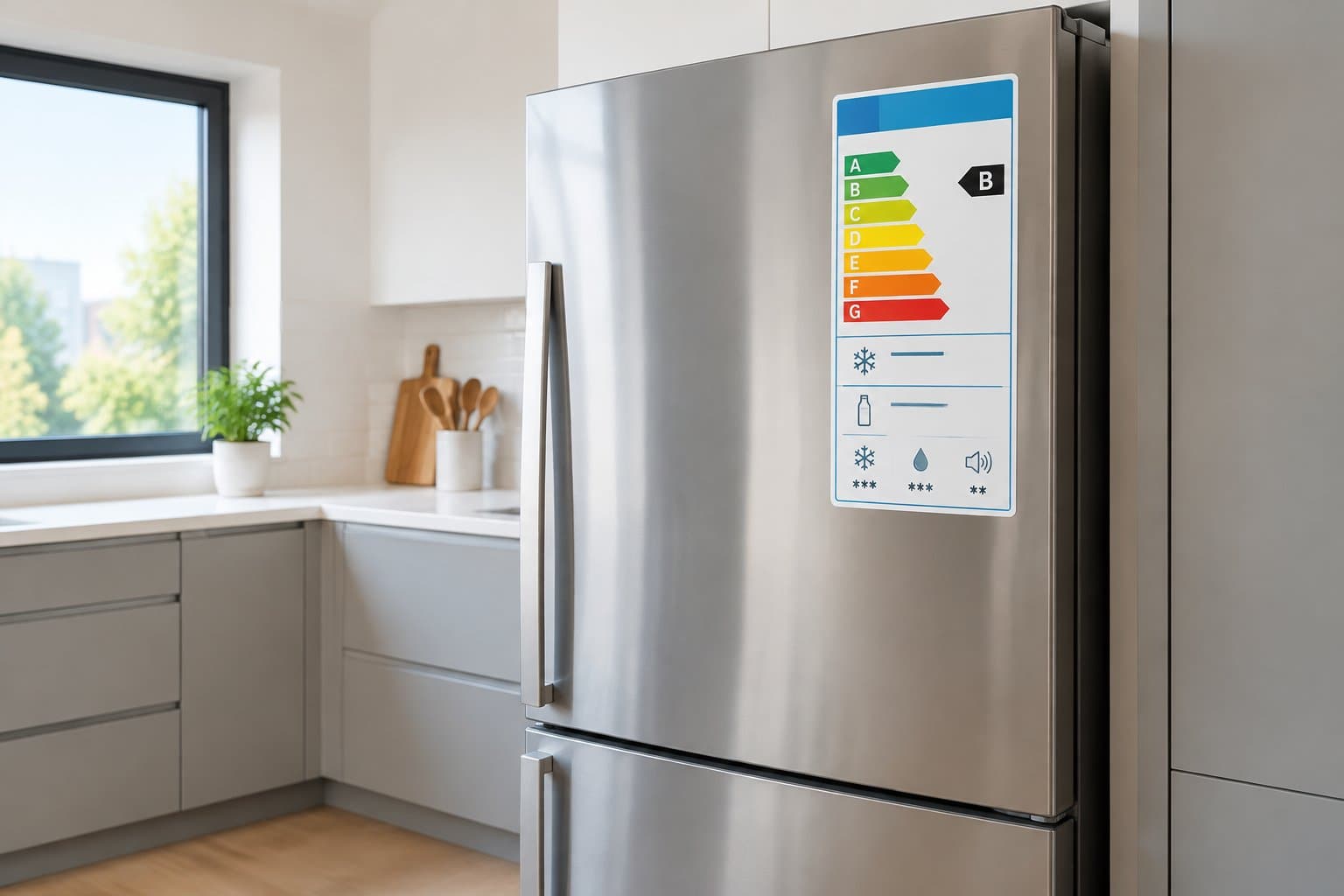

Two refrigerators sit side by side in the store. One costs less to buy, the other has a lower yearly cost on its yellow tag, and you can't tell which saves more once it's running in your kitchen.
That yellow tag is the EnergyGuide label. Read its kilowatt-hour figure alongside your own electric rate and the purchase price, and you can work out which appliance costs less to own.
What Do the Numbers on an EnergyGuide Label Mean?
The EnergyGuide label shows an estimated yearly operating cost, a cost range for similar models, and an estimated yearly energy use, in kilowatt-hours (kWh) for electric appliances. Each number answers a different question about the model in front of you.
Under the FTC's Energy Labeling Rule, manufacturers of most major home appliances must attach labels to their products. The FTC's shopping guide lists the appliances that carry one: boilers, ceiling fans, central air conditioners, clothes washers, dishwashers, freezers, furnaces, heat pumps, pool heaters, refrigerators, televisions, water heaters, and room and portable air conditioners.
Estimated Yearly Operating Cost
This dollar figure estimates what the appliance costs to run for a year. The FTC's guide on how to use the EnergyGuide label explains that it's an estimate based on typical use and a national average price for energy, and that your actual cost depends on how you use the appliance and your local energy price.
If you run the dishwasher every night or pay more than average for electricity, your real cost will differ. Use the printed figure to compare models side by side, then run your own numbers.
Cost Range for Similar Models
The label also places the model on a scale. The FTC's summary of the Energy Labeling Rule describes it as a range for comparing the highest and lowest energy cost for similar models.
A model near the low end of its range is relatively efficient compared with similar appliances. One near the high end costs more to run than most of its peers. Because the range only covers similar models, use it to compare like with like.
Estimated Yearly Electricity Use in kWh
This figure tells you how much electricity the appliance is expected to use in a year. It's the most useful number on the label, because you can multiply it by your own electricity rate to get a cost that reflects your actual bill.
A dishwasher rated at 240 kWh per year uses less electricity than one rated at 300 kWh per year, assuming similar use.
How Much Will the Appliance Cost at Your Electric Rate?
Multiply the label's yearly kWh figure by your electric rate to estimate the cost for your home instead of the national average.
Find the Rate on Your Utility Bill
Your bill usually lists the price you pay per kWh, in cents or dollars. If it splits the charge into supply and delivery, add the per-kWh parts together for your full rate. Your utility's website usually lists your current rate plan if the bill isn't handy.
Rates vary widely by state. For a benchmark, the U.S. Energy Information Administration's Electric Power Monthly publishes average electricity prices by sector and state, including residential prices.
Multiply Your Rate by the Label's Annual kWh
- Find the estimated yearly electricity use on the EnergyGuide label.
- Find your electric rate per kWh on your utility bill.
- Multiply the two numbers together.
For example, a refrigerator rated at 400 kWh per year costs about $64 a year at $0.16 per kWh. The same refrigerator at $0.28 per kWh costs about $112 a year, nearly double, simply because of where you live.
How Does ENERGY STAR Differ from EnergyGuide?
ENERGY STAR is a certification mark that tells you a model meets efficiency requirements. The EnergyGuide label gives you estimated cost and energy-use numbers.
The two work together, and ENERGY STAR notes that manufacturers sometimes build the ENERGY STAR logo into the EnergyGuide label itself.
What the ENERGY STAR Mark Tells You
To use the mark, manufacturers sign a formal agreement with the U.S. Environmental Protection Agency (EPA), and products must be third-party certified against the program's performance requirements.
According to ENERGY STAR's certification overview, the EPA oversees more than twenty certification bodies and more than 700 recognized labs, tests a subset of products after they reach the market each year, and periodically audits labeling on store shelves.
The efficiency edge varies by product. ENERGY STAR's refrigerator guidance says certified refrigerators are about 9 percent more energy efficient than models that meet the federal minimum.
Why You Still Need to Compare EnergyGuide Numbers
The ENERGY STAR mark tells you a model is efficient. It doesn't tell you the exact yearly cost or how the model compares with other certified models.
Two ENERGY STAR refrigerators can still have different kWh ratings and different yearly costs. Checking the EnergyGuide label on each one shows you which certified model costs less to run in your home.
Which Appliance Costs Less Over Time?
The appliance with the lower total of purchase price plus operating cost over the years you'll own it costs less over time, even when its price tag is higher.
Compare Models of Similar Size and Features
Compare appliances in the same category and size range. The same ENERGY STAR refrigerator guidance notes that larger refrigerators generally use more energy and that top-freezer models tend to use the least, compared with bottom-freezer and side-by-side designs. Match size, configuration, and features before you compare kWh figures.
Add Purchase Price and Estimated Operating Costs
- Note the purchase price of each model you're considering.
- Calculate each model's yearly operating cost at your own electric rate.
- Multiply the yearly cost by the number of years you expect to own the appliance.
- Add that total to the purchase price.
A refrigerator priced $150 higher that costs $20 less per year to run pays back the difference in about 7.5 years. If you expect to keep it longer than that, the more efficient model comes out ahead.
The same math helps when you're budgeting for home repairs and replacements down the road.
Account for Expected Lifespan
The number of years you plug into step 3 matters as much as the rate. Base it on how long that type of appliance typically lasts, and use the same number for every model you compare.
This average appliance lifespan chart gives typical ranges for refrigerators, dishwashers, washers, and dryers.
Keep the Numbers That Matter After You Buy
Once you've chosen an appliance, save its EnergyGuide numbers along with the model number, purchase date, and price. You'll need those details again when you check a warranty, compare your actual bills against the estimate, or document appliances before selling the home.
Delivery day is the easiest time to capture it all. Snap a photo of the label before you peel it off and add the appliance to your home inventory while the paperwork is still on the counter. Keep the receipt with it, too; here's why appliance purchase receipts matter long after the sale.
Frequently Asked Questions
Is the EnergyGuide yearly cost what I will actually pay?
Probably not exactly. The FTC says the estimated yearly operating cost is based on typical use and a national average energy price, so your cost depends on your habits and local rate. For a closer number, multiply the label's yearly kWh figure by your own electric rate.
What does the cost range on an EnergyGuide label compare?
It shows the highest and lowest estimated energy costs for similar models, so you can see whether the model you're looking at is relatively efficient or relatively costly to run compared with others of the same type.
Where can I find an EnergyGuide label when shopping online?
Look near the price on the product page. FTC rules require websites advertising covered appliances to show an image of the label, or a link to it, near the price on product pages. If you can't find it, check the manufacturer's website.
Does an ENERGY STAR mark mean an appliance is the cheapest to run?
Not necessarily. ENERGY STAR certification means the model meets the program's efficiency requirements, but two certified models can still have different yearly operating costs. Compare the EnergyGuide numbers on each to find the lower-cost option.
Can I compare EnergyGuide labels for refrigerators of different sizes?
Only with care. Larger refrigerators generally use more energy, and the label's cost range covers only similar models. For a fair comparison, stick to models of similar size, configuration, and features.
Track What Your Appliance Really Costs
The label gives you an estimate on day one; your records show what happens after that. In Manse, you can save each appliance's energy details, purchase price, and receipt in one place and check them against your bills for years to come.