
Your oven quits heating right before dinner, or the display flashes an error code you have never seen before. You open the manual drawer looking for the model number and find takeout menus instead.
That gap between "something is wrong" and "I know what to do next" is where most homeowners lose time and money on oven repair. A few safe checks can rule out the simple stuff before you pay for a service call.
In this guide, you will find the safe checks to run first, how to match your symptom to your oven type, when to stop troubleshooting, and how to prepare for a technician visit so it goes faster. You will also see what drives repair cost and how to decide if repair still makes sense. Read through before you pick up the phone.
Start With These Safe Checks
Before assuming the worst, run through a short list of checks that take less than ten minutes and often solve the problem outright.
Confirm Power, Settings, and Preheat Time
Start with the basics you overlook when you are frustrated and hungry. Check that the oven is plugged in fully and that the outlet has power, especially after any cleaning or moving of the appliance.
Next, check your circuit breakers. A tripped breaker can cut power to an electric oven without any other warning signs, and resetting it can solve the issue instantly in some cases.
Confirm you selected bake or the correct mode, not just the clock or a timer function. Some ovens take eight to fifteen minutes to preheat, so give it time before assuming it is broken.
Once power and settings check out, look at the door and rack next.
Inspect the Oven Door, Seal, and Oven Rack
A door that will not close fully lets heat escape and throws off your cooking results. Worn hinges, a damaged gasket, or a bent latch bracket are the usual culprits.
Look for food debris caught in the door seal or a gasket that looks flattened or torn. Wipe it clean and try closing the door again before assuming a part has failed.
Check the oven rack position too. A rack set too close to the heating element can scorch the top while the inside stays undercooked, mimicking a heating problem that isn't really there.
Wipe the door gasket and check for tears or gaps
Test the latch by closing the door firmly and listening for a click
Reposition the rack to the middle slot and retest a bake cycle
With power, settings, and the door ruled out, the next step is finding out exactly what oven you own.
Find the Model Number and Read the Manual
Your model number tells you which parts fit your oven and which manual sections apply. It is usually printed on a plate near the door frame, inside the door edge, or on the back panel. If the plate is worn or the numbers run together, this guide to decoding appliance model numbers can help you make sense of what you're looking at.
Once you have it, a quick manual search often points you straight to the error code or symptom you are seeing. Many manufacturers post manuals online if the paper copy is long gone, and this resource for finding and storing appliance manuals shows where to start.
This is also a good time to build a habit that pays off later. Snap a photo of the model number and the error code on the display, then save both somewhere you can find again, so the next call to oven repair services starts with answers instead of guesswork.
With your model number in hand, you can match your specific symptom to your oven type.
Match the Symptom to Your Oven Type
Electric and gas ovens fail differently, so the fix depends heavily on what powers your oven.
When an Electric Oven Is Not Heating
A faulty heating element is the most common reason an electric oven stops heating. You can often see this visually: a working element glows red evenly, while a failed one may show a visible break or dark spot.
If the element looks fine but the oven still will not heat, the temperature sensor, a blown fuse, or the control board could be the cause. These parts sit inside the appliance and are harder to check without opening panels.
Visible break or blister on the bake element
Oven powers on but never gets hot
Uneven glow across the element when it is running
Electric oven element repair is sometimes a DIY-friendly swap, but anything involving the control board should go to a technician.
When a Gas Oven Will Not Ignite
A gas oven that will not ignite usually points to a faulty igniter, the same part that causes a gas stove burner won't light complaint on the cooktop. A weak igniter glows but never gets hot enough to release the gas safety valve.
Listen for a clicking sound and watch for the igniter glow. If it glows a long time without lighting, the igniter is likely the failing part and needs replacement.
If you smell gas at any point during this check, stop immediately. That symptom moves past troubleshooting and into a safety issue covered in the next section.
Why Food Cooks Unevenly or the Display Shows an Error
Uneven cooking often traces back to a faulty control board misreading the internal temperature, or a convection oven fan that has stopped circulating air properly. Either issue throws off bake times without an obvious visible cause.
Error codes on the display are your fastest diagnostic clue. Manufacturers assign specific codes to specific failures, so the code you see maps directly to a known problem in the manual.
Photograph the code the moment it appears, since some ovens clear the display after a power cycle. That photo, paired with your model number, gives a technician exactly what they need before they even walk in the door.
Know When to Stop Troubleshooting
Some symptoms are not troubleshooting opportunities; they are stop signs. Knowing the difference protects your home and your safety.
Gas Smells, Sparks, and Other Urgent Warning Signs
If you smell gas near your oven, turn off the appliance, shut off the gas supply if you can do so safely, and leave the area. Do not attempt further checks or flip switches near the unit.
Sparks, visible arcing, or a burning electrical smell call for the same response on an electric oven. Cut power at the circuit breaker rather than unplugging near sparks.
Gas odor before or during ignition attempts
Visible sparks or arcing near the back panel
Burning smell not tied to food or spills
Oven cutting power repeatedly without a clear cause
These situations need professional oven repair, not another round of home checks.
Internal Parts That Need a Licensed Technician
Control boards, gas safety valves, and internal wiring sit behind panels for a reason. Opening them without training risks injury and can void any remaining warranty coverage.
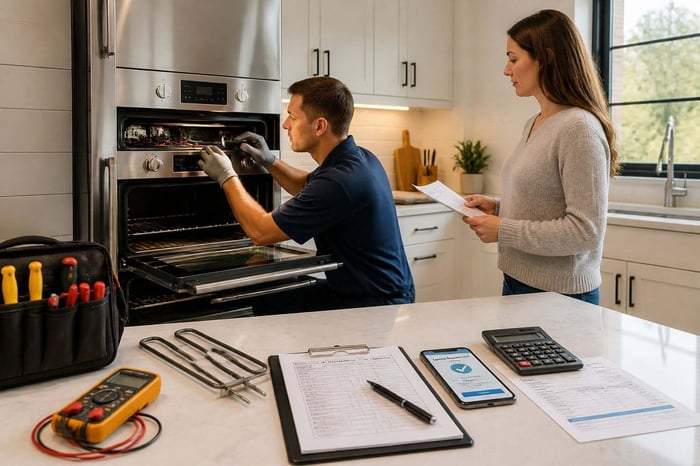
A licensed technician brings testing equipment to confirm a diagnosis instead of guessing. That accuracy saves you from paying for a part that wasn't the real problem.
Appliance repair professionals also carry the parts most likely to match your model, especially if you can give them the model number as soon as they arrive.
When an Electrician May Be the Right Call
If the issue traces back to your home's wiring rather than the oven itself, such as a breaker that trips regardless of which appliance is plugged in, an electrician is the right call instead of an oven repair service.
Recurring breaker trips, warm outlets, or flickering lights elsewhere in the kitchen point toward house wiring rather than the appliance. Mixing them up wastes a service call and delays the real fix.
Once you know which type of professional you need, the next step is making sure that visit goes as smoothly and quickly as possible.
Prepare for a Faster Service Visit
A little preparation before the technician arrives turns a long visit into a short one, and a guess into a confirmed fix.
Record the Symptom Before It Changes
Oven problems are often intermittent, which makes them hard to describe accurately after the fact. Write down exactly what happened: the error code, the sound, how long it took to fail, and what you were cooking.
A photo or short video of the symptom, taken the moment it happens, is worth more than a verbal description given days later. Technicians ask specific questions, and a record beats a fuzzy memory every time.
Gather Warranty and Purchase Details
Before the appointment, track down your purchase date, receipt, and any home warranty or manufacturer warranty documents. These determine whether the repair is covered or comes fully out of pocket.
This is exactly the kind of information that disappears in drawers and inboxes over time. Keeping your model number, purchase date, and warranty status together in one place, the way Manse organizes appliance records, means you never have to dig for paperwork while a technician waits.
Purchase receipt or order confirmation
Manufacturer warranty card or registration confirmation
Any home warranty plan details, if applicable
Model and serial number, photographed or written down
With those details ready, you can ask sharper questions once the technician is in front of you.
Ask About Diagnosis, Parts, and Work Guarantees
Ask whether the quote includes a diagnostic fee, whether it uses genuine replacement parts, and whether the repair comes with a written guarantee on labor and parts. These three answers tell you a lot about the quality of the oven repair service.
Some companies advertise a done right promise or similar guarantee on their work. Confirm what that covers and for how long before agreeing to the repair.
Once you have a quote in hand, you can weigh it against the bigger question: is this oven still worth fixing?
Decide Whether Repair Still Makes Sense
The repair quote is only half the picture. The other half is your oven's age and how it compares to the cost of a new one.
What Drives Oven Repair Cost
Oven repair cost depends on the part involved, your oven type, and local labor rates. A heating element or igniter swap sits on the lower end, while a control board replacement can approach the cost of a budget new oven.
Stove repair pricing follows similar logic, since burners and igniters are common failure points across both gas ranges and ovens. Ask for a written estimate before work begins to avoid surprises on the invoice.
Compare the Age, Failure, and Replacement Price
Most ovens last between thirteen and twenty years with normal use and care. If your oven is under ten years old and the repair is a single, well-defined part, repair usually makes sense.
If your oven is approaching fifteen years and the quote involves the control board or multiple parts failing close together, replacement often costs less over time than repeated repairs. Weigh the repair price against roughly half the cost of a comparable new oven as a rough guideline.
Keep the Next Service Call Documented
Whichever way you decide, save the outcome. Note what failed, what it cost, and which technician did the work.
That record becomes valuable the next time something goes wrong, whether the same part fails again under warranty or a different issue comes up. A simple habit of logging repairs against your appliance's model number, as part of a broader home maintenance checklist, turns every future oven repair service call into a faster, better-informed conversation.
Frequently Asked Questions
Is It Worth Repairing Your Oven or Replacing It?
It depends on age and the part involved. An oven under ten years old with a single failed part, like an igniter or heating element, is usually worth repairing, while an older oven needing a control board often costs nearly as much as replacing it.
What Does a Typical Oven Service Call Cost?
Most service calls include a diagnostic fee plus the cost of parts and labor, which varies by region and part. Simple fixes like an igniter or element tend to cost less than control board or gas valve repairs.
Why Is Your Oven Not Heating to the Right Temperature?
A miscalibrated or failing temperature sensor is the most common cause, though a worn heating element or a damaged door seal that lets heat escape can also be responsible. Checking the door seal and rack position first rules out the easiest explanations.
What Are the Most Common Signs That an Oven Needs Professional Service?
Recurring error codes, a burning smell unrelated to food, visible sparks, or a gas odor all point to professional oven repair rather than a DIY fix. Uneven cooking that persists after checking the rack and seal also signals an internal part failure.
Can You Safely Fix an Oven Yourself Before Calling a Technician?
Yes, for surface-level checks like confirming power, resetting breakers, cleaning the door seal, and visually inspecting the heating element. Anything involving the control board, gas valve, or internal wiring should go to a licensed technician.
How Do You Find a Qualified Technician for a Gas or Electric Oven?
Look for technicians who specialize in your oven type, and ask whether they use genuine replacement parts and offer a written labor guarantee. Having your model number, warranty status, and symptom notes ready helps you get an accurate quote faster.
Keep Your Oven's History Ready for Next Time
Most oven problems come down to a handful of causes: a failed element, a weak igniter, a worn seal, or a sensor sending the wrong reading. Running through the safe checks first often solves the problem, or at least tells you exactly what to say when you call for help.
When professional oven repair is the right call, the homeowners who move fastest have their model number, warranty status, and past repair notes ready. That preparation turns a stressful call into a short, confident conversation.
Manse gives you a free, private place to store your oven's model number, manual, warranty, and repair receipts, so the next time something goes wrong, you are not searching; you are ready. See how it works.