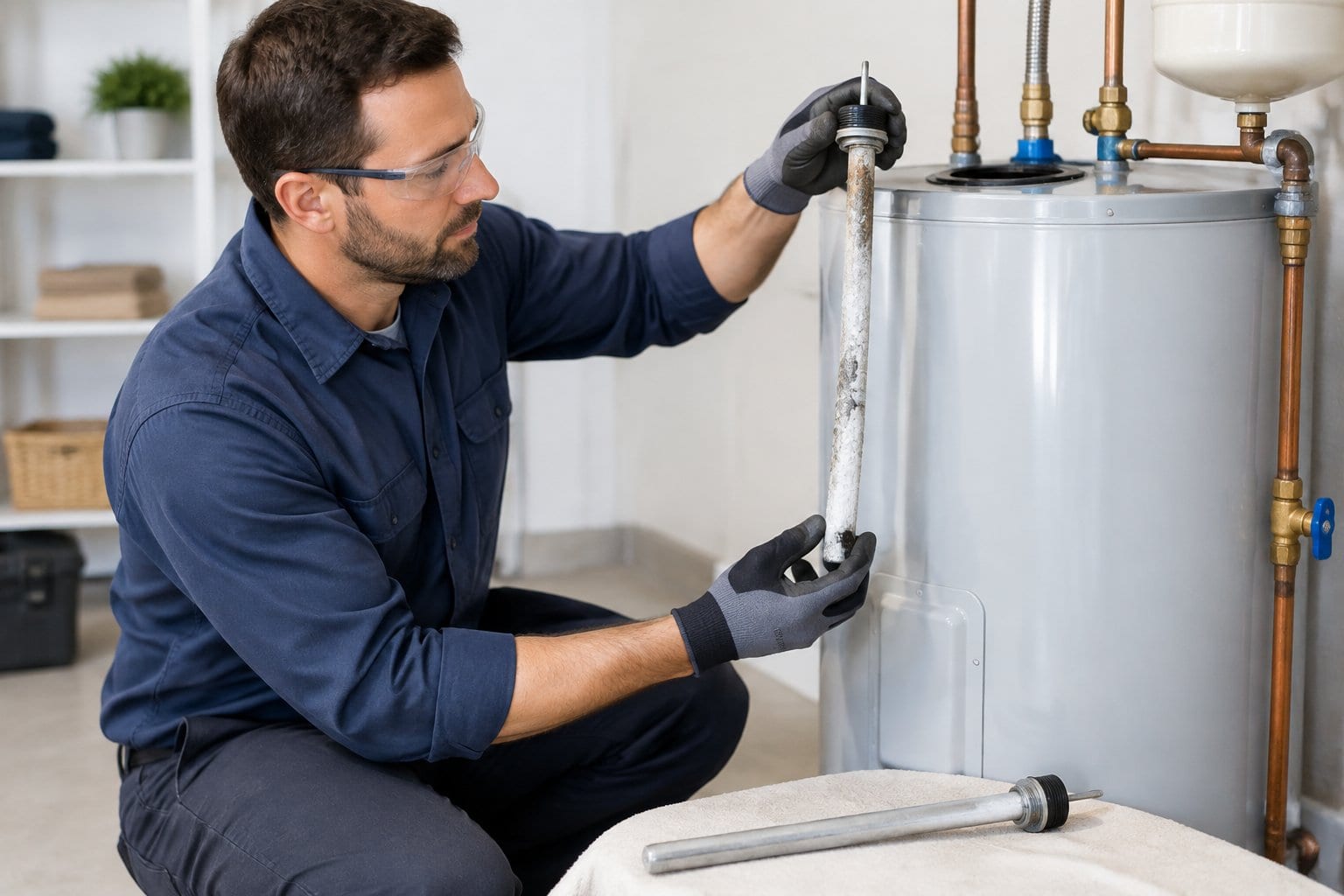

Pull and inspect your water heater's anode rod every few years, and replace it once the steel core wire is showing or most of the metal has been eaten away. On untreated city water a rod often lasts several years. Softened water, well water and heavy hot water use can wear one out much sooner, so the first inspection tells you more than any calendar rule.
Swapping the rod is a one or two hour job if you have a big socket, a breaker bar and enough headroom above the tank. The hard parts are breaking a rod loose that hasn't moved in a decade, and buying a replacement that matches your tank.
Why a Tank Needs a Sacrificial Rod
Inside a steel tank full of hot water, corrosion is inevitable. The question is only what corrodes first. The anode rod is a length of magnesium, aluminum or aluminum-zinc alloy wrapped around a steel core wire, and because those metals are more reactive than steel, the water attacks the rod instead of the tank. Bradford White describes the rod as consumed as it gives up its electrons to protect the carbon steel.
The glass lining inside most tanks does a lot of the work, but no lining is perfect. Tiny gaps expose bare steel, especially around welds and fittings, and the rod covers those spots. Once the rod is gone, rust starts at those gaps and works outward. By the time you see a drip at the base, the tank is usually past saving.
How Fast Rods Wear and What a Spent One Looks Like
Water chemistry sets the pace. Softened water is more conductive, so a rod can disappear far faster than the tank's warranty period. Hard water, well water, a high thermostat setting and a large family's hot water use all speed things up too.
The practical approach is to pull the rod on a newer tank around year two or three and look at it. A rod that still has most of its diameter can go back in, and you know your wear rate. If it's half gone, you've learned that your water is hard on rods and the next check needs to come sooner. Write down the date and what you saw; our guide to what belongs in a water heater service record covers the rest of that log.
A rod needs replacing when:
- The core wire is exposed for several inches. A common rule of thumb is about 6 inches of bare wire.
- It has thinned to well under its original diameter, or broken off.
- It's buried in hard white or tan scale, which stops it reacting even if metal remains.
Other symptoms point toward the rod without proving anything. Popping or rumbling is usually sediment on the tank floor. Rusty hot water can come from the tank or from old galvanized pipe. A rotten egg smell in the hot water only is often a reaction between sulfate in the water and a magnesium rod, which has its own fix (usually a change of rod material) rather than a simple replacement.
Choosing the Right Replacement
Material
Magnesium gives the strongest protection and suits most untreated municipal water. Bradford White calls it a leading anode material for protecting the tank, but recommends aluminum where water is more conductive, which includes softened water and water with a lower pH. Aluminum rods last longer in those conditions.
A powered anode uses a small electrical current from a wall outlet instead of metal that dissolves. It doesn't wear away, which makes it appealing for well water with persistent odor, but it does need an outlet near the heater and a manufacturer-compatible install.
Size and connection
Rods sit in one of two places. Many tanks have a dedicated hex-head port on top, sometimes hidden under a plastic cap or a section of the top cover. Others use a combination rod built into the hot water outlet nipple, so you'll only see the hot and cold pipes. Most residential ports use 3/4 inch NPT threads, but lengths vary with tank height and capacity, and some manufacturers specify particular rod types.
Here the exact model matters more than any general advice. The rod's part number, length and type are listed in your heater's manual, and fitting the wrong one can raise warranty questions on a tank that may still be covered. Manse identifies the heater from its rating plate and brings up that specific manual and its warranty status, so you're not guessing from the outside of the tank.
Headroom
A solid rod comes out straight up, so you need roughly its full length of clearance above the heater. Closets, attics and low basements rarely have it. A segmented, flexible rod bends as you feed it in and hangs straight once it's inside the tank.
Replacing the Rod Step by Step
You'll need a 1-1/16 inch six-point deep socket (a 12-point socket tends to round the hex), a breaker bar, a garden hose, a bucket, thread tape or the sealant your manual specifies, gloves and a helper.
- Shut off the heat source. Turn a gas control to Off, or switch off the breaker for an electric heater.
- Let the water cool. Give it a few hours; tank water can scald.
- Close the cold supply valve above the heater, then open a hot tap somewhere in the house to relieve pressure.
- Drain a few gallons. Connect the hose to the drain valve and run it to a floor drain or outside. Keep most of the water in the tank, because the weight helps stop the tank twisting when you lean on the wrench.
- Break the rod loose. Fit the socket and turn counterclockwise with steady pressure while your helper steadies the tank. Lift the old rod straight out.
- Install the new rod. Wrap the threads clockwise with tape (or apply the approved sealant), lower the rod in, start it by hand to avoid cross-threading, then snug it with the socket without overtightening.
- Refill before you restore heat. Close the drain, open the cold supply with a hot tap still open, and wait until water runs steadily with no sputtering. An electric heater switched on with dry elements will burn them out.
- Check for drips at the rod fitting, then turn the power back on or relight the gas following the label on the heater.
When to Hand the Job to a Plumber
Stop if the rod won't move and the tank starts to rock. Twisting a tank can stress the gas connector, shift the flue or loosen the water connections, and none of those are worth the saving. Plumbers usually break seized rods with an impact wrench, whose short bursts put far less twisting force on the tank than a long breaker bar.
Also call someone if the hex head is buried in foam insulation, there's no room to get a socket on it, or you can't confidently isolate the gas or power. Any smell of gas means stopping work, getting everyone out and phoning the gas company once you're outside.
A new rod only protects steel that's still sound. If you see water pooling under the tank or rust on the jacket, the money belongs in a replacement rather than a rod. Our guide to a leaking water heater helps you tell a loose fitting from a failing tank.
Frequently Asked Questions
Should I remove the anode rod to stop a smell?
No. Taking the rod out leaves the tank unprotected and can affect the manufacturer's warranty. If odor is the problem, the usual answer is a different rod material or a powered anode, along with disinfecting the tank.
Do tankless water heaters have anode rods?
Most don't, because there's no steel storage tank to protect. They need periodic descaling instead. Some hybrid and combination units are different, so check the manual for yours.
Is a stuck anode rod a sign the tank is failing?
Not by itself. Rods often fuse into their ports with scale after years of heating cycles. A seized rod just means it needs more controlled force than a hand tool gives, which is where a plumber's impact wrench helps.
Will a new rod make an old tank last longer?
It can help on a tank that's still sound, but it won't reverse corrosion that has already started. If the heater is well into its second decade, check its warranty status and condition before spending on parts. Here's how to confirm whether a water heater is still under warranty before you buy parts.
Know Which Rod Your Tank Takes
The rating plate on the side of your water heater holds everything needed to buy the right rod, but it rarely tells you the length or type outright. Add a photo of it to Manse and it identifies the exact heater, then answers with the rod specification from that model's manual, its warranty coverage and any recalls. Keep the inspection date and rod condition in the same folio and your next check has a real starting point. See how the Manse house manager app works.