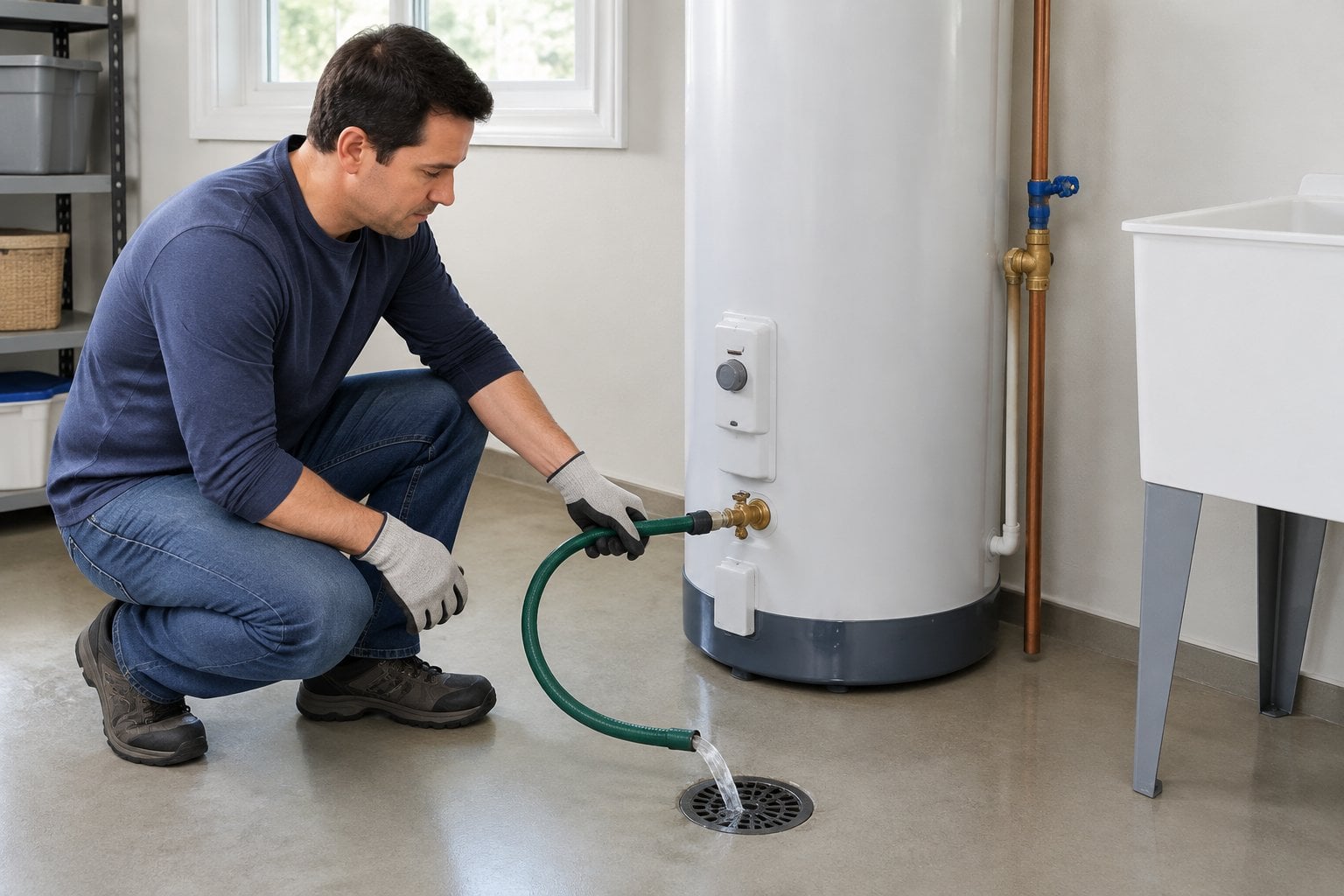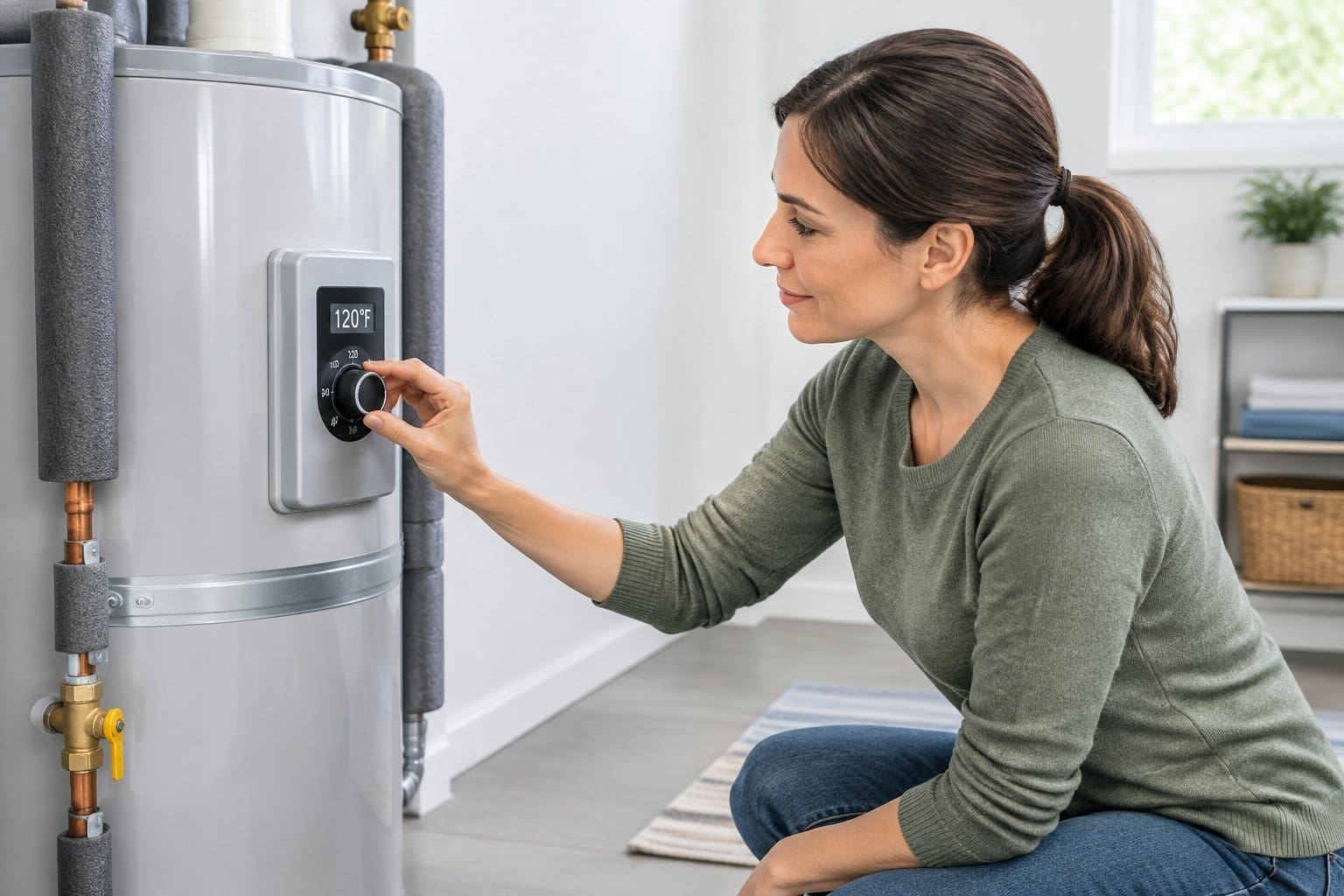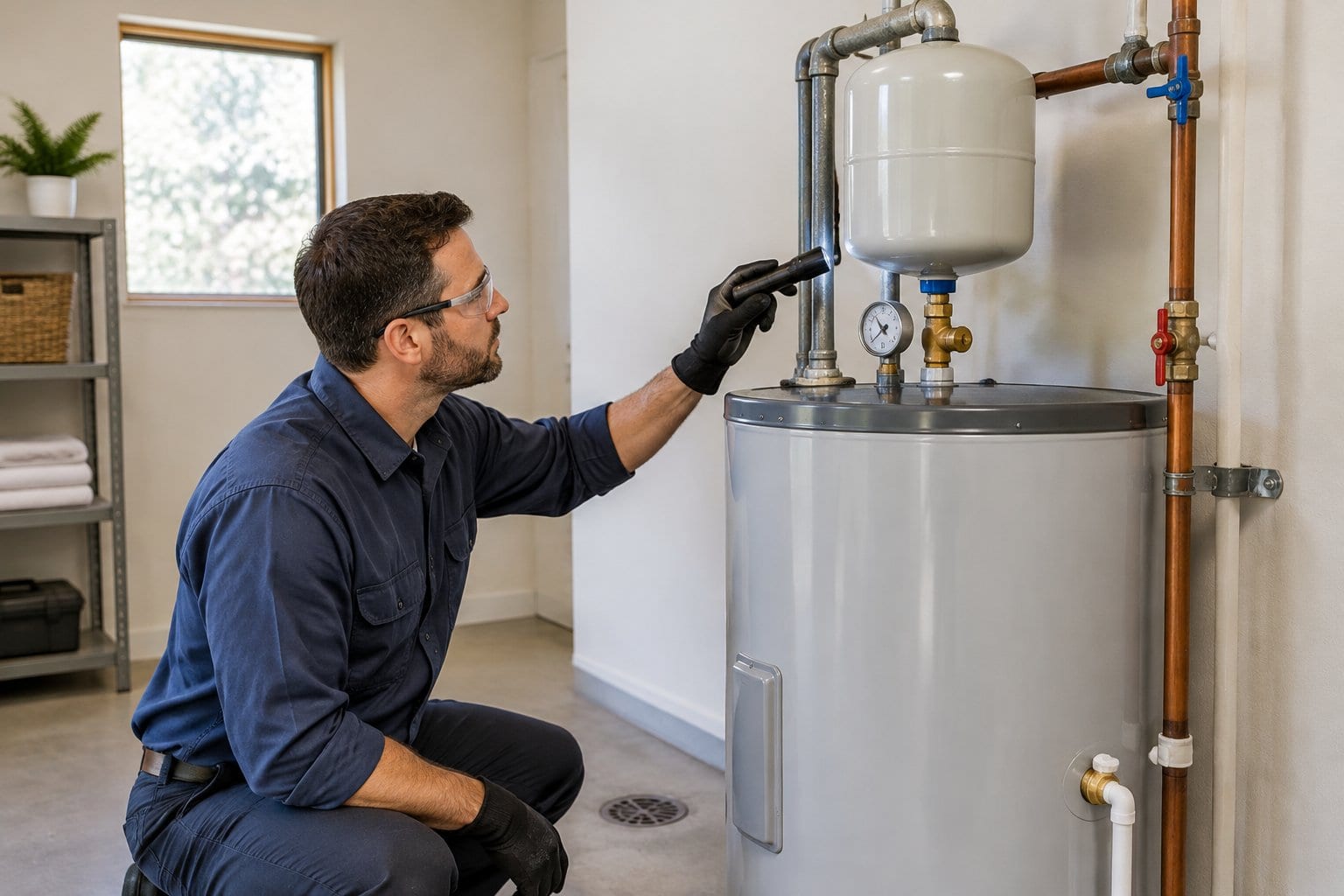

You need a water heater expansion tank if your plumbing is a closed system, meaning a check valve, backflow preventer or pressure-reducing valve on the main line stops water flowing back toward the street. For a typical 40 or 50 gallon tank heater at normal house pressure, the usual answer is a 2-gallon expansion tank with its air charge set to match your incoming water pressure. A failed one shows up as a relief valve that drips after the heater runs, banging pipes, or a tank that sounds solid all the way up when you tap it.
The physics is simple. Water takes up more room when it's heated, and it can't be squeezed. In an open system the extra volume drifts back into the city main. In a closed system it has nowhere to go, so pressure climbs every time the burner or elements cycle. A.O. Smith's technical bulletin on thermal expansion gives an example of water in a closed tank at 50 psi reaching 250 psi after a rise of just 10 degrees. Real plumbing flexes and leaks a little, so you won't see that number, but the repeated spikes wear on faucet cartridges, toilet fill valves, appliance hoses and the heater itself.
How to Tell If Your System Is Closed
Walk to where the main water line enters the house and to the meter if you can reach it. A pressure-reducing valve is usually a bell-shaped brass fitting with an adjusting bolt or screw on top. Check valves and backflow preventers are often fitted at the meter, sometimes by the utility, and nothing in the house tells you they're there. A call to your water utility settles it. A water softener can also act as a one-way device on some installations.
The heater gives clues too. A relief valve that drips during heating cycles when nobody is using water, pipes that creak while the heater recovers, and faucets that drip only at certain times all point to pressure building with nowhere to go.
Plumbing codes in many areas require thermal expansion control wherever one of those one-way devices makes the system closed, and an inspector will usually check for it when a water heater is replaced under permit. That's why a plumber's replacement quote often includes an expansion tank you didn't ask for. It's there for a reason. Your local building department has the final word on what applies at your address.
Buying an older home? The plumbing inspection checklist for older homes covers this alongside the other supply-side checks worth making before closing.
Why the Relief Valve Isn't the Answer
Many homeowners replace a dripping temperature and pressure relief valve two or three times before anyone mentions expansion. The valve is doing what it should: pressure climbs, it opens. A.O. Smith is blunt that the relief valve is an emergency device and must not be relied on to handle thermal expansion, because repeated opening wears it out and it can fail to work when it really matters. The same bulletin notes that failures caused by uncompensated expansion aren't covered by its warranty.
That last point is worth taking seriously on any heater still under warranty. The installation manual for your specific model says what the manufacturer requires, and Manse can identify the heater from its label and answer from that manual and its warranty terms, so you know whether a closed system without expansion control could put a claim at risk.
Never cap, plug or shorten a relief valve discharge pipe to stop a drip.
Checking an Expansion Tank You Already Have
An expansion tank is a small steel vessel divided by a rubber diaphragm or bladder. Air is sealed on one side; the other side connects to your cold water line. As heated water expands, it pushes into the tank and compresses the air. When a tap opens, the air pushes it back. Most failures come from a torn bladder or air leaking out through the valve, which leaves the tank full of water and useless.
Look and tap
Check the tank body and the threaded connection on top for drips, rust streaks or bubbling paint. Water coming from the body itself, rather than the fitting, means the tank has failed. Then tap it with your knuckles. The air end, where the tire-style valve sits, should sound hollow and the water end duller. A tank that sounds solid from end to end is waterlogged.
Watch the pressure through a heating cycle
A hose-thread pressure gauge with a red peak-tracking needle is one of the most useful cheap tools a homeowner can own. Screw it onto a laundry faucet or outdoor spigot with nothing running in the house and note the reading. That's your static pressure. Leave it on while the water heater runs a full cycle with all taps closed. With a working expansion tank, the needle should rise only a little and hold. A climb toward the pressure stamped on the relief valve (commonly 150 psi) means the expansion isn't being absorbed.
Test the air charge
The tank's air side has to be read with the water side empty of pressure, or the number is meaningless. A.O. Smith's expansion tank instructions describe the sequence:
- Turn the water heater to its vacation or pilot setting, or switch off its breaker.
- Close the main cold water supply valve.
- Open a nearby faucet and let it run until the water stops, which relieves the line pressure.
- Remove the cap on the air valve, at the end opposite the water connection, and read it with a tire gauge.
- Adjust as needed with a manual tire pump, or press the valve core to let air out.
- Reopen the cold supply and restore the heater.
If water spits out of the air valve, the bladder has torn and the tank needs replacing. If you get air, the reading should match your static water pressure.
Sizing and Installation
Three numbers drive the size: the heater's capacity (on its rating plate), your static water pressure and the maximum water temperature. Higher pressure leaves the air cushion less room to work, so a high-pressure home can need a larger tank for the same heater. In A.O. Smith's sizing chart, 40 and 50 gallon heaters both take a 2-gallon tank at inlet pressures from 40 to 80 psi.
If pressure is high to begin with, fix that first. A.O. Smith recommends keeping inlet pressure at 60 psi or less and fitting a pressure-reducing valve where it's above 80 psi. Adding that valve also closes the system, which is one more reason the two are usually installed together.
A few installation details matter:
- Air charge first. Tanks leave the factory precharged (A.O. Smith's ship at 38 psi), and the charge must be adjusted to match your incoming pressure before the tank goes on the line.
- Cold side only. The tank goes on the cold supply feeding the heater, and A.O. Smith specifies at least 18 inches from the heater's cold inlet. The hot side shortens bladder life.
- Support. A full tank is heavy. Follow the manufacturer's mounting instructions; some are designed to hang from the piping vertically, others need a bracket or strap.
Cutting into the supply line, fitting a pressure-reducing valve and anything involving a gas heater's connections are jobs for a licensed plumber, and many jurisdictions require a permit. Keep the invoice and the permit sign-off; our guide to tracking contractor work on your home explains what's worth holding onto.
Frequently Asked Questions
Does a tankless water heater need an expansion tank?
Usually not, because it doesn't store a large volume of heated water. The expansion problem comes from a full tank heating up with nowhere for the extra volume to go. Check your local code and the heater's installation manual, since some installations still call for one.
How often should the air charge be checked?
Once a year is a sensible habit, and any time the relief valve starts dripping again. Tanks lose a little air over time, and topping up the charge before the bladder is stressed can extend its life.
Does a dripping relief valve always mean the expansion tank has failed?
No. A drip can also come from a thermostat set very high, high street pressure or a relief valve that's simply worn. Measure static pressure and the tank's air charge first. If both are normal, have a plumber look at the valve itself.
Will a home inspector flag a missing expansion tank?
Often, especially on a closed system or a recently replaced heater. It's one of the items that shows up in the plumbing section of a home inspection checklist, and an easy one to resolve before or after closing.
Pressure Problems Start With the Right Model
Whether a dripping relief valve is a warranty issue, an expansion problem or a worn valve depends on the heater you have and what its manual requires. Manse identifies your water heater from a photo of its rating plate, then answers with the installation requirements, warranty terms and recall history for that exact unit. See how Manse works.